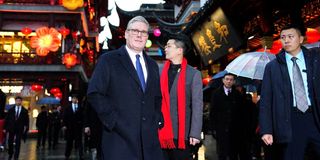
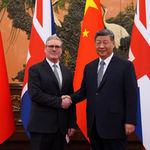
Hong Kong/Beijing. British Prime Minister Keir Starmer’s visit to China has handed Beijing a diplomatic win in its rivalry with Washington, but the agreements he secured also underscore the limits middle powers face when trying to balance relations between China and the United States.
Starmer’s trip follows a similar visit by Canadian Prime Minister Mark Carney, who struck a trade deal with Beijing before heading to Davos to promote a new global trade order as U.S. President Donald Trump disrupts long-standing alliances.
European leaders, India’s Narendra Modi and others have also visited China since Trump began his second term a year ago. However, analysts say it remains unclear what lasting economic or security benefits such visits bring for Western countries.
“Traditional U.S. allies feel hard done by and are now hedging their bets, but they are far from being able or willing to substitute China for the United States,” said John Quelch, an expert in global strategy at Duke Kunshan University.
From the perspective of London, Ottawa and other capitals, the visits are seen as a signal to Trump that alternatives exist if Washington maintains pressure on issues ranging from Greenland to renegotiating the USMCA trade deal.
But Alicia Garcia-Herrero, chief Asia-Pacific economist at Natixis, described the efforts as “superficial gestures amid stalled global growth”.
“These visits highlight the severe limits of any ‘pivot’ to China,” she said. “They expose middle powers’ vulnerability, chasing scraps while China’s export flood overwhelms their industries.”
Analysts say the visits also strengthen Beijing’s narrative of China as a reliable partner, contrasting with what they describe as Trump’s unpredictable tariff policies and mounting demands on both allies and rivals.
“President Trump’s efforts to decouple the United States from China are also decoupling the United States from the world,” Quelch added.
Wins on visas and trade
During the trip, Starmer secured 30-day visa-free travel for Britons visiting China and lower tariffs on whisky. British drugmaker AstraZeneca also announced a $15 billion investment in the country.
However, he achieved little beyond what officials described as “frank dialogue” on sensitive issues, including China’s stance on Taiwan, its closer ties with Russia following the Ukraine war, and a rights crackdown in Hong Kong.
Politicians in Britain and the United States criticised the visit, raising concerns over espionage and human rights abuses, allegations Beijing denies.
Similarly, Carney left China expecting tariff reductions on products such as canola, lobsters, crabs and peas, but the move prompted threats of 100 percent tariffs from Trump, who warned Ottawa against allowing Chinese electric vehicles into North America.
Even before Starmer concluded his visit, Trump cautioned Britain that doing business with Beijing was risky after the prime minister highlighted the economic benefits of resetting ties with China.
Trade imbalances persist
China’s imports last year were flat at $2.6 trillion, largely driven by energy and commodities from emerging markets rather than the West.
At the same time, its trade surplus rose by a fifth to a record $1.2 trillion as manufacturers expanded exports to other markets in response to U.S. tariffs.
Exports to the European Union increased 8.4 percent while imports dipped 0.4 percent. Shipments to Britain rose 7.8 percent while purchases fell 4.7 percent. With Canada, exports grew 3.2 percent while imports dropped 10.4 percent.
Eswar Prasad, a former International Monetary Fund China director, said deeper trade integration with China poses risks for countries seeking to protect or expand domestic manufacturing.
“This makes it an especially risky proposition for countries trying to protect or grow their own manufacturing industries to substantially increase trade integration with China,” he said.
“China hardly provides a safe harbour for countries trying to cope with the adverse economic effects of U.S. tariffs.”
Some analysts argue that for countries like Britain or Canada, resetting strained ties may be the most realistic outcome, particularly given previous supply chain dependencies on China.
Still, Noah Barkin, a Europe-China expert at the German Marshall Fund and Rhodium Group, described the visits as “a propaganda coup for Beijing”.
“This is not a pivot to China. It is about reducing tension with Beijing,” he said. “No country wants to be in open conflict with the two superpowers at the same time.”