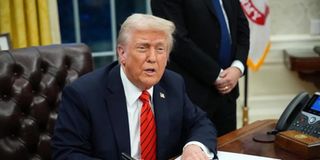
Washington. President Donald Trump on Friday signalled support for possible regime change in Iran, saying it “seems like that would be the best thing that could happen,” as the United States Department of Defense deployed a second aircraft carrier to the Middle East.
His remarks come at a time when Washington is simultaneously pursuing diplomacy with Tehran over its long-running nuclear dispute with Western powers, even as it strengthens its military presence in the region.
Sources familiar with the matter said US envoys Steve Witkoff and Jared Kushner are scheduled to hold negotiations with Iranian representatives in Geneva on Tuesday, with Oman acting as mediator. The two are also expected to meet officials from Russia and Ukraine as part of broader efforts to address the war in Ukraine.
Speaking after a military event at Fort Bragg in North Carolina, Trump criticised Iran’s leadership and said years of negotiations had failed to yield results. He declined to name who should lead Iran if change occurred but insisted there were people who could take over.
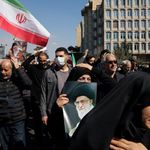
Washington wants any nuclear deal to cover not only Iran’s atomic programme but also its ballistic missiles, support for armed groups across the region and its domestic governance. Tehran says it is willing to discuss limits on its nuclear activities in exchange for sanctions relief but has ruled out linking talks to its missile programme.
Trump has repeatedly threatened military strikes if no agreement is reached, while Iran has warned it would retaliate, raising concerns about a wider regional conflict. The US previously targeted Iranian nuclear facilities in strikes last year.
Asked what remained to be struck at those sites, Trump replied: “the dust,” adding that any further action would target whatever was left.
Carrier deployments
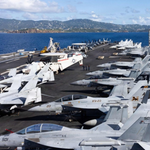
US officials described the complex process of repositioning military assets. The aircraft carrier USS Gerald R. Ford will join the USS Abraham Lincoln, alongside guided-missile destroyers, fighter jets and surveillance aircraft already moved to the Middle East in recent weeks.
The Gerald R. Ford, the newest and largest carrier in the US fleet, had been operating in the Caribbean with escort ships and earlier took part in missions near Venezuela. Trump said the second carrier was being sent “in case we don’t make a deal,” adding that it would be ready if needed.
Officials said the vessel would take at least a week to reach the Middle East. With only 11 aircraft carriers available, such deployments are significant and typically planned well in advance.
The Ford, powered by a nuclear reactor, can carry more than 75 aircraft, including F-18 Super Hornets and E-2 Hawkeye early warning planes, and is equipped with advanced radar systems. It will be supported by ships including the guided-missile cruiser USS Normandy and destroyers USS Thomas Hudner, USS Ramage, USS Carney and USS Roosevelt, which provide air, surface and anti-submarine defence capabilities.
While aircraft carrier missions usually last about nine months, they can be extended during periods of heightened military activity. Navy officials have previously warned that prolonged deployments at sea may affect crew morale.