Dar es Salaam. The $89 million budget shortfall that has forced the convening of an emergency summit of East African Heads of State, troubling as it is, may be only one symptom of a deeper malaise, The Citizen has learnt.
Beneath the financial strain lies a more corrosive crisis: mistrust among partner states, unresolved conflicts and weakening confidence in the Community’s own ability to manage its affairs.
In recent years, the EAC has expanded ambitiously, admitting the Democratic Republic of the Congo (DRC) and later Somalia, even as long-standing tensions among existing members have continued to simmer.
The conflict between Rwanda and the DRC has exposed the bloc’s limitations in conflict resolution. Accusations of support for armed groups, border tensions and diplomatic expulsions have repeatedly shaken relations.
Yet, despite EAC-led initiatives and regional force deployments, progress has often appeared fragile and externally driven, with global powers stepping in to influence ceasefire processes.
Similarly, relations between Burundi and Rwanda have periodically deteriorated over allegations of harbouring dissidents and supporting rebel groups.
The EAC, which prides itself on being a political federation in the making, has struggled to assert itself as the primary arbiter.
“The inability to resolve conflicts internally weakens the legitimacy of the Community,” argued a Dar es Salaam-based regional integration scholar, Dr Mathews Komba.
“If external actors are seen as more effective mediators, it erodes confidence in the bloc’s institutional architecture,” he said.
Beyond the Great Lakes, mistrust has quietly hardened between Tanzania and Kenya.
Trade disputes, periodic border frictions and public rhetoric have strained what is often described as the backbone relationship of the EAC.
In recent months, Kenyan activists have openly criticised Tanzanian policies, while Tanzanian authorities have linked certain Kenya-based groups to online mobilisation campaigns deemed destabilising.
Though diplomacy remains intact, the public tone has been sharper than usual.
Meanwhile, tensions between Kenya and South Sudan over trade routes, security cooperation and political alignments add another layer of complexity.
South Sudan itself continues to grapple with internal instability, raising questions about whether the bloc’s rapid expansion risks importing unresolved domestic crises into regional forums.
Can such a climate genuinely guarantee flourishing integration?
Governance deficits inside EALA
The concerns are not only political but institutional. Tanzania’s Member of the East African Legislative Assembly (EALA), Dr Abdullah Makame, has openly criticised governance lapses within the bloc’s organs.
“The (EAC) Treaty requires the Council of Ministers to present annual reports. The Council had accumulated a six-period backlog,” he noted.
“We worked and cleared the final three, but this shows the Council and Secretariat have not been up to date on their responsibilities.”
He further pointed to non-adherence to statutory requirements under Sections 8 and 10 of the Budget Act, emphasising lapses in accountability and transparency.
Such internal governance weaknesses compound the trust deficit.
If member states doubt the Secretariat’s compliance with its own legal framework, political goodwill inevitably thins.
Regional integration analyst Prof Samuel Msofe said: “When resolutions are passed but poorly implemented, or reports are delayed for years, member states begin to question the seriousness of commitments.”
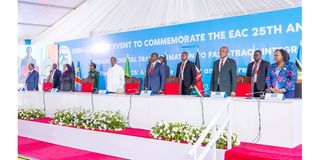
The decision by President William Ruto to call for an emergency summit as the funding gap threatens paralysis is timely.
Yet analysts argue that focusing narrowly on remittances would miss the moment.
“This is not just about balancing the books,” said Prof Msofe.
“It is about rebuilding trust. Without trust, even a fully funded Secretariat cannot deliver integration.”
The bloc’s ambition of eventually forming a political federation demands deeper solidarity than is currently evident.
The principle of non-interference often clashes with security realities, while sovereignty concerns limit collective enforcement mechanisms.
Expansion without consolidation?
The EAC now comprises eight partner states. Expansion signals attractiveness, but it also stretches fragile institutions.
Admitting countries with ongoing internal conflicts or governance challenges risks overwhelming mechanisms that are already under strain.
“What we see is widening before deepening,” noted Dr Makame. “The Community is expanding geographically without consolidating politically.”
Ahead of the March 7 summit, experts argue that the conversation must move beyond plugging the financial gap to confronting structural weaknesses head-on.
They insist that strict enforcement of Treaty obligations is non-negotiable.
“Accountability and transparency, as required under the Budget Act, should not be treated as optional but as the backbone of credibility within the Community,” emphasised the EALA MP.
Equally urgent, according to Dr Komba, is the need to strengthen the EAC’s internal conflict-resolution architecture.
He maintains that the bloc must develop binding and respected mechanisms capable of addressing disputes among partner states without defaulting to external mediation.
“If East Africa is to speak with one voice, it must first prove capable of resolving its own disagreements through its own institutions,” he noted.
Trust-building must also extend beyond presidential summits.
Scholars suggest sustained diplomatic engagement, joint parliamentary forums and people-to-people programmes to soften hardened national narratives.
Register to begin your journey to our premium contentSubscribe for full access to premium content