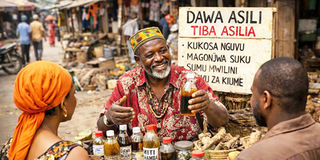
Dar es Salaam. For millions of Tanzanians, traditional medicine remains a trusted source of healing, shaped by culture, affordability and proximity.
For others, however, it has left lasting scars, physical, emotional and, in some cases, fatal, exposing the fine line between relief and risk in a sector that continues to attract widespread public reliance.
According to the Performance Audit Report on the Regulation of Traditional and Alternative Medicine, 2024, issued by the Controller and Auditor General (CAG), an estimated 60 to 80 percent of Tanzanians depend on traditional medicine for their primary healthcare needs.
The report shows that this reliance is particularly strong in communities where access to modern medical facilities is limited, and where traditional remedies are viewed as familiar, affordable and culturally acceptable.
Traditional medicine gained renewed national attention during the Covid-19 pandemic, when many citizens turned to local remedies to manage symptoms. For some users, the experience reinforced long-held beliefs that traditional medicine can complement the formal health system during times of crisis.
Even after the pandemic, the trend has continued at a rapid pace. For some, traditional remedies have delivered life-changing relief after years of frustration with conventional treatment.
In Dar es Salaam, 47-year-old businessman Hamduni Hassan told The Citizen that traditional medicine succeeded where hospital treatment repeatedly failed.
“I struggled with haemorrhoids for many years. I used different hospital medicines, but the problem kept coming back,” he said.
“In 2022, I tried traditional medicine for just three weeks. Each bottle cost Sh4,500 and I used nine bottles. The pain stopped completely, and I have never had the problem again.”
He said affordability and quick relief were central to his decision.
“I had already spent a lot of money on hospital treatment. This worked in a short time and changed my life,” he added.
Another user, Joseph Kilemela, a resident of Yombo interviewed in Mbagala, said traditional medicine helped him recover from a condition that had disrupted his personal life.
“I had a problem with my blood vessels after injuring myself. I was not in a normal condition for a long time. After using traditional medicine, I recovered fully and returned to my normal state,” he said.
Such testimonies explain why traditional medicine continues to enjoy widespread trust. But alongside these positive experiences are accounts marked by regret and irreversible consequences.
Fatuma Ally, 29, a resident of Chamazi interviewed in Manzese, described how a decision driven by desperation left her with permanent damage.
“I suffered from severe tooth pain for a long time. I went to hospital and used medicines, but the pain kept returning,” she said. “I was advised to go to Kariakoo and buy traditional medicine. I paid Sh22,000 for it.”
Instead of relief, the situation worsened.
“After using it, the pain increased. Two other weak teeth started aching badly,” she said. “In the end, I was forced to remove all of them.”
For Irene Kelvin, a resident of Tabata, the harm unfolded slowly over several years.
She began using traditional medicine in 2016 in an attempt to conceive, following advice from friends.
“I used different traditional medicine doses until 2023 without any success. When I finally went to hospital, I was told that my body had accumulated a lot of toxins,” she said.
“I was convinced that I had been bewitched and that only traditional methods could help me. I am grateful I eventually received proper treatment, but I lost many years believing something that was harming my body.”
Some of the most painful stories involve the loss of life. Mohamed Issa Mohamed, a resident of Temeke, said his family is still grappling with the consequences of long-term reliance on traditional remedies.
“My father died in 2021 after suffering kidney failure, the cause of which, we were later informed, was the use traditional medicine alongside other treatments for a long time,” he said. “My mother still strongly believes in traditional medicine and avoids going to hospital. I fear she could end up the same way my father did.”
National audit findings echo these personal accounts. According to the Annual Performance Audit Report, 2025, issued by the National Audit Office of Tanzania, at least 16 people were found dead between 2020 and September 2024 due to prohibited and dangerous traditional practices, including ramli chonganishi and rituals involving human body parts.
The deaths were reported in regions including Dodoma and Mwanza. The CAG’s 2024 report also recorded seven additional deaths in 2023 linked directly to the use of unregulated traditional medicines.
Inside hospitals, clinicians say they frequently treat patients suffering complications linked to traditional remedies, often without clear information on what was consumed.
A clinician at Temeke Regional Referral Hospital, Dr Agnes Kweka, said many patients arrive with symptoms indicative of contamination or incorrect dosage.
“We receive patients with stomach upset, skin irritation and, in some cases, organ complications after using traditional medicine. Most of them cannot tell us exactly what they took, how it was prepared or the dosage,” she said.
She explained that poor storage practices worsen the risks.
“Some medicines are kept in dirty containers or recycled bottles that are not airtight. That allows bacteria and toxins to develop,” she added.
At Bugando Medical Centre in Mwanza, Dr Emmanuel Magesa said delayed hospital visits often complicate treatment.
“Many patients come when the condition has already worsened. By that time, managing the damage becomes more difficult,” he said.
Some users who shared bitter experiences pointed to a recurring problem: the absence of proper diagnosis before being given medication.
“You just explain how you feel, and someone gives you medicine immediately. There are no tests, no records, just assumptions,” one patient said.
In response to claims of health complications linked to traditional remedies, the Ministry of Health says there is currently no scientific evidence directly confirming a causal relationship.
Acting Assistant Director in the Directorate of Curative Services, Dr Winifrida Kidima, said further studies are required to establish clear scientific links.
“There is no scientific proof demonstrating that traditional medicine causes these complications. The Ministry continues to encourage research in this area to generate evidence-based findings,” she said.
She added that the government has established a system for monitoring adverse effects in 14 regional referral hospitals offering traditional treatment under the supervision of trained practitioners.
“The monitoring of adverse effects for traditional medicines follows the same standards applied to modern medicines,” she said.
At the Institute of Traditional Medicine at Muhimbili University of Health and Allied Sciences (Muhas), researchers say the mixed experiences reported by users often stem from the difference between scientifically processed medicines and those that are not.
Researcher Dr Benson Mugaka said a product could be safe if prepared under regulated conditions, but even a beneficial plant could become dangerous if processed in unsanitary environments.
“Medicine is not only about claiming it cures. It must undergo safety trials, checks for contamination and assessment of its impact on vital organs,” he said.
He added that unsafe medicines can create new health problems for patients already seeking treatment, potentially affecting their productivity and, by extension, the nation’s workforce.
As the popularity of traditional remedies persists, the experiences of users reflect a complex reality, one that blends cultural trust, economic necessity and, at times, serious health risks.
Register to begin your journey to our premium contentSubscribe for full access to premium content