Tanzania, India sign agreement to advance traditional medicine
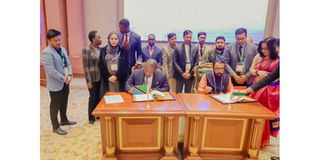
Tanzania’s minister for Health Mohamed Mchengerwa (left), formalises a new partnership with an Indian government representative during a signing ceremony in India recently. PHOTO | COURTESY
Tanzania has also invited investors from across the globe to invest in the pharmaceutical sector, assuring them of a conducive business environment.
Dar es Salaam. The governments of Tanzania and India have signed a memorandum of understanding (MoU) to develop, promote and protect traditional medicine within legal and digital frameworks, a move welcomed by the World Health Organisation (WHO).
Tanzania has also invited investors from across the globe to invest in the pharmaceutical sector, assuring them of a conducive business environment.
Speaking in India following the signing, which was witnessed by WHO Director-General Dr Tedros Ghebreyesus, Tanzanian minister for Health, Mohammed Mchengerwa, said the agreement would provide legal protection for traditional medicine.
“We believe that traditional medicine, when legally safeguarded, strengthened by science, enabled by technology, and managed with a commercial outlook, can be a key pillar in building healthier societies globally,” he said.
The minister noted that traditional medicine remains a critical component of primary healthcare in Tanzania, with approximately 60 percent of citizens using traditional healers, either alongside or prior to modern hospital care.
“This reality shows that scientific evidence is not optional but essential,” he emphasised.
On safety and quality, Mr Mchengerwa expressed full support for WHO’s 2025–2034 Global Strategy on Traditional Medicine, particularly in building evidence on safety, efficacy, and quality.
Priority will be given to community-based, cost-effective research in collaboration with government research institutions, laboratories and universities.
He highlighted Tanzania’s strong legal foundation for traditional medicine under the Traditional and Alternative Medicine Act No.
23 of 2002, enforced by the Traditional and Alternative Medicine Council, and ongoing strengthening of institutions such as the Tanzania Medicines and Medical Devices Authority (TMDA), the Government Chemist Laboratory Authority (GCLA), and the National Institute for Medical Research (NIMR).
“The aim is to professionalise traditional medicine while aligning it with international standards of quality and safety,” he said, adding that the next step is integration into formal healthcare systems.
“Tanzania is committed to incorporating traditional medicine into primary healthcare to support universal health coverage. Services are already being provided in official hospitals, with 27 verified traditional medicine products used to treat both communicable and non-communicable diseases,” he said.
The government strategy also includes a national curriculum on traditional medicine, training for modern and traditional healthcare practitioners, and fostering collaboration between traditional healers and modern healthcare providers.
Mr Mchengerwa said traditional medicine also serves as a catalyst for innovation and economic growth. To date, 141 traditional medicine products are registered in Tanzania, over 90 per cent of which are produced by local small-scale entrepreneurs under the Health Sector Strategic Plan.
He noted that Tanzania is promoting public-private partnerships to strengthen cultivation, processing, manufacturing, quality, market access, and exports of medicinal plants.
“Investment in technology transfer and innovation is welcome to ensure Tanzanian traditional medicine products meet international market standards,” he added, stressing that ethical practices, knowledge preservation, and fair benefit-sharing remain essential.
During the meeting, Mr Mchengerwa held discussions with pharmaceutical investors to attract wide-ranging investment to Tanzania.
At the closing session, Indian Prime Minister Narendra Modi highlighted the importance of protecting intellectual property and traditional knowledge, while leveraging artificial intelligence and digital technologies to safeguard, validate, and preserve traditional medicine.
He emphasised that technology should complement, not replace, traditional healers, enhancing and protecting their expertise.