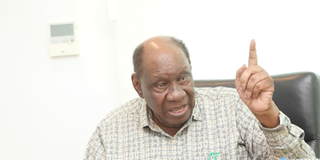
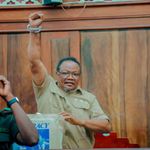
Dar es Salaam. The CCM Vice-Chairman for Mainland Tanzania, Mr Stephen Wasira, said under the current circumstances the reconciliation framework should involve the government to lead society towards unity.
He elaborated on reconciliation at a time when some political leaders are in the custody of state organs, stressing that it should not be conflated with criminality; if an individual breaks the law, they must be held accountable like any other citizen.
Mr Wasira’s remarks come as the Chadema Vice-Chairman for Mainland Tanzania, Mr John Heche, has questioned whether there is any need for reconciliation and, if so, who should reconcile with whom.
He further asked how the party could consider entering reconciliation talks while its chairman, Mr Tundu Lissu, remains in remand over what he described as politically motivated cases.
The question of reconciliation resurfaced following demonstrations that turned violent on October 29 and 30 last year, resulting in deaths and the destruction of public and private property.
Since those incidents, divergent views have emerged between proponents of reconciliation and its opponents, who insist the government must first fulfil certain conditions.
Mr Wasira made the remarks during an exclusive interview with The Citizen’s sister newspaper, Mwananchi, at his office at the CCM sub-office on Lumumba Street in Dar es Salaam.
Who should reconcile with whom?
Clarifying the matter, Mr Wasira said reconciliation should involve the government leading society, as a large segment of the population was affected.
“Society has been greatly affected and comprises many people; there are youths who say they were the ones who went out to demonstrate, adults who were affected, people whose relatives were killed, and those who lost property and had their houses burnt.
“All these are part of society, so when you seek reconciliation, you must bring all these groups together, discuss where we reached and how we move forward; that is where reconciliation takes place,” he said.
Asked how reconciliation would proceed while political cases are before the courts, Mr Wasira said there are no political cases in the country; rather, people wrongly assume that holding a position grants immunity from prosecution.
“Reconciliation is not a substitute for the law, it does not override the law, and no one is above it; if you are a political leader, you must respect the law, and if you err, you will be charged like any other citizen,” he said.
He cautioned against conflating reconciliation with crime, hinting that one party’s members’ arrests are often publicised without detailing the alleged offences.
From the manner in which that party, which he did not name, announces arrests, he said one might assume the offence was party membership, yet often there are other grounds.
He said Tanzania has more than 60 million people, and it is not only members of a particular party who commit offences, stressing that CCM members also serve prison sentences.
“There are no political cases; if you commit an offence and break the law, does that become a political case? A political case does not go to court; look across countries. A political case does not give you the right to defend yourself,” said Mr Wasira.
October 29 incidents a stain
He acknowledged that the incidents tarnished Tanzania’s image, though they were not unprecedented, recalling that in 1964 the Tanganyika Rifles mutinied, two years after independence.
In Mr Wasira’s view, what occurred on October 29 was not demonstrations but a rebellion, as they were conducted at night and not in accordance with legal procedures.
“They vandalised ATMs, and later I do not know whether money was taken because banks say they had deposited Sh80 million and did not find it; the demonstrations consumed funds,” he said.
“From there, they went to Igoma in Mwanza, attempting to enter banks at night, so why call them demonstrations? Even the devil can be given a good name if you love him enough, but this is a crime,” he said.
He said that at one point, police fired warning shots in the air, but people continued advancing, forcing officers to use live ammunition in self-defence, yet they persisted.
On the commission investigating October 29
He said President Samia Suluhu Hassan’s commission to investigate the October 29 violence was not established to probe the government, but to examine what happened, its causes, and related issues.
“If you say government, people dying, I am among those who strongly detest seeing loss of life; I myself do not wish to die, you cannot celebrate people dying,” he said.
However, he maintained that the government did not go into the streets seeking to kill people; there was a trigger, namely, riots that erupted from unknown quarters, with individuals burning public buildings and private property.
“You cannot say that commission… I truly wonder, Commission Chairman, Judge Othman Chande, was once entrusted by the United Nations to investigate the cause of the death of the UN Secretary-General,” said Mr Wasira.
In his view, accountability cannot rest solely with the government but also involves organisers, questioning how youths mobilised and carried out destruction.
On claims that people were paid, he said that was not an instruction to the commission but the government’s assessment, as state organs often possess preliminary information when incidents occur.
“If the commission concludes there was no money, so be it, but those are not instructions; the terms of reference are the instructions. Go investigate and submit a report. You cannot be President and remain entirely uninformed until a commission reports,” said Mr Wasira.
His view on justice, peace
On the debate over which comes first, justice or peace, Mr Wasira said he agrees with both, stressing that they are like the chicken and the egg.
Asked which is the egg and which is the chicken, he replied, “Who comes first, the chicken that lays eggs or the egg that hatches a chicken? It is impossible to speak of justice in isolation.”
He said that where peace prevails, even if justice is deficient, it can be pursued within that peaceful environment, insisting it is difficult to demand justice amid instability.
“There is a strong relationship between peace and justice, just like a chicken and an egg,” said Mr Wasira.
House burnt
Asked to clarify reports that his house in Bunda, Mara Region, was burnt, Mr Wasira said he preferred not to dwell on personal matters and noted that had anyone been inside, fatalities would have been reported.
“Let us focus on national matters; as for my house, I will build another. Those who burnt it, God is there and will question why they did so and what they gained,” he said.
However, he stated that it was not a luxury residence and that he had built it from legitimate earnings, adding that throughout his career, he had never stolen from the United Republic of Tanzania and could present his financial records.
“In my history, the assets I own were acquired from allowances while serving as an MP, and I used the parliamentary allowances of the people of Bunda to build in Bunda. Since it was burnt, and my parliamentary term had ended, what remains is that it is not a major issue,” said Mr Wasira.
Register to begin your journey to our premium contentSubscribe for full access to premium content