Dar es Salaam. On paper, Tanzania’s 2025 Form Four results look encouraging. The overall pass rate in the Certificate of Secondary Education Examination (CSEE) has risen to 94.98 percent, up from 92.37 percent in 2024.
In absolute numbers, 526,620 school candidates attained Divisions I to IV, compared to 477,262 the previous year.
At first glance, this suggests steady progress in secondary education. But a closer look at the results’ data, overall performance by division reveals a more complex story, one where improvement in access and progression coexists with persistent weaknesses in learning outcomes.
One positive signal is the decline in candidates who obtained Division 0, the category that reflects outright failure.
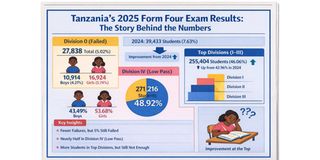
In 2025, a total of 27,838 candidates, equivalent to 5.02 percent of all school candidates who sat for the examination, fell into this category. This is a notable improvement from 2024, when 39,433 candidates (7.63 percent) obtained Division 0.
The gender breakdown, however, tells its own story. Among those who scored Division 0 in 2025, 16,924 were girls (5.74 percent) while 10,914 were boys (4.21 percent). Although both groups improved compared to 2024, girls remain more vulnerable to complete failure than boys.
This reduction in Division 0 candidates partly explains the rise in the overall pass rate. But it does not automatically mean that learning quality has improved across the board.
The dominance of Division IV
The most striking feature of the 2025 results is the size of Division IV, the lowest passing grade.
In 2025, 271,216 candidates, or 48.92 percent, obtained Division IV. In 2024, the figure was slightly higher in percentage terms, 255,309 candidates (49.41 percent), but the pattern remains the same: nearly half of all candidates who pass do so at the minimum level.
This matters because Division IV, while officially a pass, often signals weak mastery of subjects. Many students in this category struggle to progress to competitive A-level combinations or technical pathways without remedial support.
Gender disparities are again evident. In 2025, 53.68 percent of girls who passed fell into Division IV, compared to 43.49 percent of boys. This means that although more girls are staying in school and sitting the examination, a large proportion are clustering at the bottom of the pass scale.
There is, however, genuine improvement at the upper end of performance. Candidates obtaining Divisions I to III increased from 221,953 (42.96 percent) in 2024 to 255,404 (46.06 percent) in 2025, an improvement of 3.1 percentage points.
Division I alone rose from 45,838 candidates (8.87 percent) in 2024 to 56,413 (10.17 percent) in 2025. Similar gains were recorded in Divisions II and III. These trends suggest that a growing group of students is achieving stronger academic outcomes.
Yet this group remains smaller than the large cohort stuck in Division IV. The system is producing more high achievers, but not at a pace that shifts the overall balance.
What the numbers really mean
Taken together, the data suggest that Tanzania’s education system is improving in survival and completion, but struggling with depth of learning. Fewer students are failing outright, which is a success worth acknowledging.
However, the concentration of candidates in Division IV points to gaps in foundational understanding, particularly in key subjects such as mathematics and sciences.
The results also raise questions about equity. Girls continue to outperform boys in enrolment and participation, yet they are overrepresented in the weakest performance bands.
This points to broader social, pedagogical and resource-related factors that go beyond examination statistics.
The 2025 results confirm that progress is being made, but they also warn against celebrating the pass rate alone. A system where nearly half of candidates pass at the lowest level risks producing graduates who hold certificates but lack strong skills.
The challenge for policymakers is no longer just about getting students through the exam, but about lifting them out of Division IV and into stronger performance bands.
Until that happens, rising pass rates will remain an incomplete measure of success.
Register to begin your journey to our premium contentSubscribe for full access to premium content