UDSM moves to align university curricula with global labour market
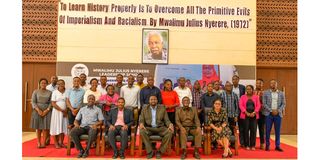
Prof Habib Mahama from Qatar University (centre in front row) and Academics from the University of Dar es Salaam Business School pose for a group photo during their recent curriculum transformation workshop at the Mwalimu Julius Nyerere Leadership School in Kibaha, Coat Region. PHOTO|COURTESY OF THE UNIVERSITY OF DAR ES SALAAM
Dar es Salaam. The University of Dar es Salaam (UDSM) has embarked on a process to revise its curricula as part of efforts to improve the employability and global competitiveness of its graduates.
Recently, the university hosted a three-day capacity-building workshop for academic staff, aimed at strengthening curriculum design and review in line with global academic and labour market demands.
Organised as part of a formal collaboration agreement between UDSM and Qatar University (QU), the workshop was supported through project financing from the Qatar Fund for Development (QFFD).
Speaking during the training workshop held at the Mwalimu Julius Nyerere Leadership School in Kibaha, Coast Region, Dr Theresia Dominic of UDSM said the sessions were designed to equip lecturers with practical skills and global perspectives needed to modernise university programmes.
“The training focuses on strengthening academic curricula so that our graduates are not only relevant locally, but can also compete internationally,” said Dr Dominic.
She noted that the workshop was facilitated by the lead of the Qatar University–African University Business Schools Project, Prof Habib Mahama.
Prof Mahama, who is from the Qatar University College of Business and Economics, serves as a project specialist under the initiative.
According to Dr Dominic, Prof Mahama is guiding UDSM lecturers on best practices in curriculum development and review, alignment with industry needs, and benchmarking against globally competitive universities.
“The expert from the Qatar University College of Business and Economics is guiding us on how to strengthen our curricula. Curriculum reforms should begin at the university level and gradually cascade to lower levels of education,” she said.
She added that aligning UDSM programmes with international standards would help ensure graduates are better prepared for both regional and global labour markets, at a time when employers increasingly demand practical skills, adaptability and global exposure.
The dean of the University of Dar es Salaam Business School (UDBS), Prof Omari Mbura, said the training workshop draws directly from the experience of the Qatar University College of Business and Economics, which ranks among the top global business schools.
“This training focuses on the best practices adopted by leading universities, particularly in curriculum review and the development of sustainable academic strategies that respond to changing global trends,” said Prof Mbura.
He noted that the emphasis is not only on revising course content, but also on rethinking teaching approaches to ensure programmes remain relevant to modern economies.
“The curriculum reforms will help position the University of Dar es Salaam among leading universities in the world,” he said.
Meanwhile, the coordinator of the project at UDSM, Dr Mesia Ilomo, who is also a senior lecturer in the Department of Finance, said the initiative is part of broader efforts to build the capacity of business schools in Africa in the areas of curriculum, strategic planning and research.
He said the project focuses on strengthening academic expertise and excellence, improving market responsiveness, sharpening strategic direction, and enabling universities to produce graduates who can compete effectively in an increasingly globalised job market.
“Our aim is to ensure African universities are not left behind in global academic and labour market developments. This is feasible by learning from successful partners such as Qatar University, which has strategically transformed over time to become one of the top universities in the world,” said Dr Ilomo.
The training workshop comes at a time when higher learning institutions in Tanzania are under growing pressure to regularly review their curricula, as required by regulators, and to ensure graduates leave universities with skills that meet the expectations of employers, both locally and internationally.