Dar es Salaam. The growing burden of kidney disease in Tanzania is driving demand for modern treatment options that are less invasive and more affordable than conventional surgery.
Government data show that the number of kidney patients receiving dialysis services at health facilities increased from 1,017 in 2019 to 3,327 in 2025, underscoring rising demand for specialised kidney care.
Against this backdrop, Sino Kangning Polyclinic has introduced technology that uses focused sound waves to break kidney stones into tiny fragments, allowing them to pass naturally through urine without the need for surgery.
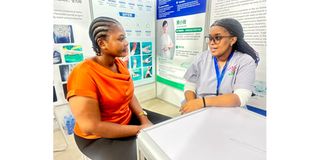
Speaking during the 50th Dar es Salaam International Trade Fair, Dr Kanansia Mbowe said the procedure eliminates the need for surgical incisions and prolonged hospital stays.
"The patient does not undergo an operation or require admission. The machine directs sound waves at the kidney stone, breaking it into sand-like particles that are later expelled naturally through urine," she said.
Dr Mbowe said the technology, commonly known as extracorporeal shock wave lithotripsy (ESWL), is currently available at only a few health facilities in Tanzania but is already helping many patients avoid surgery and lengthy recovery periods.
She said many people still believe surgery is the only effective treatment for kidney stones, yet advances in medical technology now provide a safer, less invasive alternative for suitable patients.
In addition to kidney stone treatment, the facility has specialist urologists who manage a wide range of conditions affecting the kidneys, bladder and urinary tract.
Dr Mbowe also revealed that the facility has brought orthopaedic and microsurgery specialists from China who are capable of reattaching severed body parts, including fingers, hands and limbs.
She said such procedures have the highest chance of success when patients reach hospital within eight hours of the injury.
"Within that period, blood vessels and nerves can still be repaired. After that, the detached body part gradually loses viability because of the lack of blood supply, reducing the chances of successful reattachment," she explained.
The specialists also provide treatment for chronic diabetic wounds through skin grafting, scar reconstruction and reproductive health services.
One of the visitors to the facility, Mr Manjit Kumar, said the introduction of non-surgical kidney stone treatment could significantly reduce treatment costs for patients.
"Patients will spend less time in hospital, recover faster and return to work much sooner. This will also reduce the financial burden associated with surgery," he said.