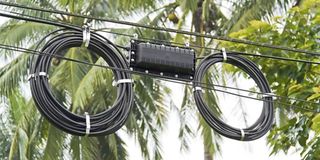
Dar es Salaam. The rapid expansion of fibre-optic infrastructure across Dar es Salaam is raising fresh concerns about compliance with telecommunications regulations, urban planning, and the visual impact on the city’s landscape. A recent survey in neighbourhoods including Masaki, Mikocheni, Kijitonyama and Kinondoni found that several streets have more than five separate poles carrying fibre cables from different telecommunications operators.
The proliferation of poles has sparked debate over visual pollution and whether service providers are complying with infrastructure-sharing regulations.
Communications statistics for December 2025 show that internet subscriptions to homes and offices through fibre-optic technologies increased by between 157 and 217 percent over two years, reflecting a shift towards fibre-to-the-home (FTTH) and fibre-to-the-office (FTTO) connections.
The report indicates that FTTH and FTTO connections rose by 157 percent, from 54,290 in March 2024 to 139,317 in December 2025.
FTTH increased by 150 percent, from 49,164 to 123,052, while FTTO grew by 219 percent, from 5,126 to 16,265.
Data also shows that 5G geographical coverage increased from 2.5 percent in 2024 to 10.5 percent by December last year, while population 5G coverage rose from 3.1 percent to 28.9 percent during the same period.
A Dar es Salaam resident, Ms Beatrice Mosha, said many streets are now lined with poles carrying orange or black equipment, with cables running in multiple directions. “At first I thought they were for landline telephones, but later I learned they are fibre-optic cables. When there are too many poles, the appearance is not good. There are simply too many cables in the city,” she said.
Environmental experts say the expansion must be properly managed. National Environment Management Council (NEMC) Manager for Registration of Environmental Experts, Ms Edika Masisi, said uncontrolled installation of towers could affect the city’s appearance.
“If towers are everywhere, it affects the beauty of the city,” she said, noting that NEMC mainly handles large towers and environmental impact assessments, while fibre poles fall under the communications sector. She added that institutions work collaboratively and advise on best installation practices.
She said that there are no known health risks associated with fibre cables, but poor planning could contribute to environmental pollution and reduce the city’s attractiveness. A telecommunications lecturer at the University of Dar es Salaam, Dr Moses Ismail said many operators prefer overhead fibre networks because they are cheaper and easier to maintain than underground systems.
“They can remove old cables and install new ones without major disruptions, making overhead installations more practical,” he said.
However, he cautioned that without a clear regulatory strategy, uncontrolled pole installations could undermine urban aesthetics.
What the regulations state
Tanzania Communications Regulatory Authority (TCRA) Communications Manager, Mr Rolf Kibaja, said all licensed internet service providers must obtain a fibre permit before installing infrastructure, including cables, poles and ducts. Where infrastructure already exists, providers are required to share it. If none exists, they may install new infrastructure, provided it is designed to accommodate at least three other service providers.
All installations must comply with technical and safety standards set by the Tanzania Bureau of Standards (TBS), as well as guidelines from the Tanzania Rural and Urban Roads Agency (Tarura), the Tanzania National Roads Agency (Tanroads), and relevant local government authorities.
“TCRA also conducts inspections to assess compliance. Operators found with non-compliant infrastructure are issued directives to make corrections. Repeated failure to comply may result in warnings, fines, or cancellation of permits and licences,” he said.
He added that 5G facilities are typically installed on existing base stations and must comply with the Electronic and Postal Communications (Access, Co-location and Infrastructure Sharing) Regulations, 2018, along with standards prescribed by TBS.
Under the regulations, infrastructure owners are required to design facilities that can be shared by other service providers to prevent unnecessary duplication.
TCRA maintains that infrastructure sharing is the most effective way to expand high-speed internet while minimising environmental and urban planning challenges. The authority also reiterated that optical fibre cables do not emit electromagnetic radiation and that established standards ensure structural safety under normal use.
Register to begin your journey to our premium contentSubscribe for full access to premium content