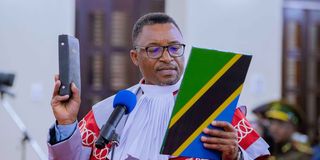
Dar es Salaam. A Tanzanian justuce has been shortlisted for election to the bench of the International Criminal Court (ICC) as the court elects six judges this year.
According to a statement from the ICC website, Deo John Nangela, a justice of the Court of Appeal, is among the candidates who will be elected during the Assembly of States Parties’ 25th session scheduled for December 7–17, 2026.
Dr Nangela is listed among other candidates from Uganda, Ghana, Japan and Colombia.
Justice Nangela is widely regarded as one of Tanzania’s experienced legal professionals. Appointed to the Court of Appeal in January 2025 by President Samia Suluhu Hassan, he previously served as Principal Judge of the High Court in Sumbawanga and also worked in the Commercial Court.
Before joining the Judiciary, he was Director of Business Regulation at the Fair Competition Commission.
Academically, he holds a PhD in Law from the University of Cape Town, a Master of Laws from SOAS University of London, and a Bachelor of Laws from the University of Dar es Salaam. He also lectured at the University of Dar es Salaam’s School of Law for nearly a decade.
His areas of expertise include commercial and competition law, electronic contracts, dispute resolution and human rights.
Election process
Under Article 36 of the Rome Statute, ICC judges are elected from individuals of high moral character, integrity and recognised competence, qualified to hold the highest judicial offices in their home countries.
To ensure transparency and uphold ethical standards, the Assembly of States Parties has established a permanent vetting mechanism through the Independent Oversight Mechanism, which allows confidential reporting of any allegations of misconduct against nominees.
The allegations of misconduct should be submitted not later than May 31, 2026, ICC stated.
Recently, the ICC Deputy Prosecutor Mr Mame Mandiaye Niang, recently met leaders from several African states, including Tanzania, on the sidelines of the 39th summit of the African Union in Addis Ababa, where discussions centred on strengthening cooperation, promoting accountability for international crimes and safeguarding victims’ rights.
During the talks, Tanzania’s Minister for Foreign Affairs and East African Cooperation, Mahmoud Thabit Kombo, joined counterparts from other African nations in reaffirming support for closer collaboration with the ICC’s Office of the Prosecutor.
Mr Niang said the court remains ready to work “shoulder to shoulder” with African countries to combat impunity, noting that stronger national justice systems and regional partnerships are essential in addressing atrocities such as war crimes, crimes against humanity and genocide.
He also stressed that victims must remain central to justice efforts, urging governments to ensure their voices are heard and their rights protected through credible legal processes.