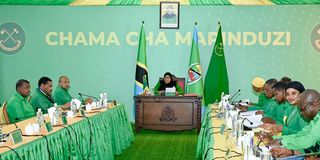
Dar es Salaam. CCM on Thursday, February 5, 2026, marks 49 years since its formation in 1977, an event hailed as historic in Tanzania’s political landscape.
The anniversary coincides with an appraisal of the party’s journey, direction and prospects.
For nearly half a century, CCM, born from the merger of the Tanganyika African National Union (Tanu) and Zanzibar’s Afro-Shirazi Party (ASP), has led the country based on its policies and ideology.
It is credited with achievements such as maintaining peace, national unity, and expanding social services, including education and healthcare.
However, the party has continued to face challenges arising from changing times, including growing political competition under the multiparty system, greater public awareness of citizens’ rights and responsibilities, and increasing demands for accountability and transparency.
These challenges have forced CCM to undertake frequent internal reforms, including amendments to its constitution, to align with societal needs and expectations.
Currently, the most prominent challenge is the evolving mindset of the digital generation, which relies on Information and Communication Technology (ICT), questions policies and leaders’ decisions, and expects prompt, well-reasoned answers.
Social media has become the main platform for political debate among this generation, which is also grappling with unemployment, a reality that has compelled the party to adapt its communication and persuasion strategies.
Former Secretary of the Zanzibar Special Committee on Ideology and Publicity, Catherine Nao, believes CCM will remain in power if it adheres to the core principles outlined in the party members’ oath.
“Always speak the truth, avoid intrigue, and reject corruption as the enemy of justice, neither accepting nor giving bribes. If we live by these promises of membership, CCM will endure,” says Ms Nao.
She notes that despite having numerous leaders at various levels, some occasionally fail to honour the membership oath, causing internal turbulence within the party.
“We conduct self-assessment, set aside time to criticise one another and say ‘no’ where necessary. That is what enables us to move forward,” she says.
Ms Nao recalls that before the late President John Magufuli assumed office on November 5, 2015, CCM went through a difficult period, with some members reluctant even to wear party uniforms.
“During Magufuli’s tenure, he restored public trust and made the party popular again. Even now, if a problem arises, we sit down and correct it,” she says.
She adds that no one truly hates CCM, but the party is undergoing stages of growth, expressing hope that leaders will reform themselves accordingly.
“CCM has no problem, and no one can bring it down. The key is to live the oath with integrity to remain attractive and loved by citizens,” she says.
Recalling fourth-phase President Jakaya Kikwete’s leadership, Ms Nao says he once told the National Executive Council (NEC) that a new generation with different needs would eventually emerge.
“Mr Kikwete said a generation would come demanding major reforms, transparency, and accountability, and that it would reject propaganda. That generation is today’s,” she says.
She stresses that if the party fails to uphold accountability and openness, it will face challenges, but she believes CCM can adapt if it chooses to act.
“Today’s society demands transparency. CCM must be accountable, not through stubbornness or force, but through commitment,” she says.
Ms Nao adds that one of CCM’s greatest achievements is preserving the Union between Tanganyika and Zanzibar, noting that challenges have always been resolved through dialogue.
“Tanzania has continued to understand itself and listen to citizens’ needs without discrimination, living with one voice and the language of unity,” she says.
She notes that despite internal challenges and personal interests among some members, CCM’s size remains its main strength, and it continues to carry the hopes of many Tanzanians.
Ms Nao stresses that transparency in decisions affecting public interests, especially the passage of government bills, must be given greater emphasis.
“Members of Parliament should scrutinise bills carefully and safeguard citizens’ interests, and where changes are needed, they should be ready to advise the government,” she says.
She adds that both the party and government must respond to young people’s needs, commending the creation of a dedicated youth ministry and urging leaders to fully involve youth in decisions that affect them.
Analysts’ perspective
Political analyst Harry Mwinuka says CCM has a unique history, as it was born from the merger of two parties that led the struggle for national independence.
Since independence, he says, CCM has carried the responsibility of leading the State with the aim of delivering development and social, political and economic wellbeing to citizens.
“CCM is a historic party that has governed the country for a long time, seeking to fulfil the expectations of citizens and its members, although not all Tanzanians are members,” says Mr Mwinuka.
He adds that despite global changes, the party remains relied upon by every Tanzanian and therefore has a duty to serve all citizens without discrimination, while adjusting its thinking and approach to match current realities.
Mr Mwinuka says many long-ruling political parties in Africa have faced major challenges, with some losing influence or being voted out after failing to adapt to changing ideas and philosophies.
“For CCM to remain strong in this new era, it must change and focus on current citizens’ needs and the kind of people it leads, rather than clinging to outdated mindsets,” he says.
He adds that reforms are inevitable, especially in an era of rapid technological advancement, and the party must be ready to embrace and manage them for the nation’s benefit.
Mr Mwinuka stresses the importance of engaging young people, noting that a large share of the population is youth with different needs and priorities.
“It is important for the party to understand young people’s interests, what they prioritise and how to engage them politically and socially,” he says.
He adds that the party should empower capable youth to take leadership roles and drive its agenda in line with current demands, while improving social services and reducing living costs for various groups.
‘CCM must do this’
The Coordinator of the Tanzania Human Rights Defenders Coalition (THRDC), Mr Onesmo Ole Ngurumwa, argues that CCM has declined and is no longer widely accepted in the current political environment.
He says that to survive and participate peacefully in elections, the party must change its mindset and operational vision.
However, CCM Zanzibar Secretary for Ideology and Publicity Khamis Mbeto Khamis dismisses the claims, saying critics lack evidence and have not conducted research to support their arguments.
“CCM is a party capable of fielding candidates nationwide. How can you say it is not accepted? Other parties do not have that capacity. They make random urban representations,” he says.
Mr Mbeto adds that CCM has representation from grassroots to the national level and that claims of declining popularity are emotional and intended to create sensational stories.
He says that when CCM conducts internal elections, the whole world pays attention.
Continuing his remarks, Mr Ole Ngurumwa says CCM must recognise that today’s world is different from when it was founded, requiring fair competition, accountability, awareness, educated leadership, and issue-based politics rather than propaganda.
“CCM must understand that we are in a different world. It is a world of competition, accountability, awareness, and issue-based politics,” he says.
He adds that any party wishing to lead the State today must fully consider citizens’ demands and stop imposing decisions instead of listening to the people’s voices.
“Citizens must be heard. Everything requires accountability. If they want good electoral systems, they must do what Tanzanians need, not what they personally want,” he says.
Mr Ole Ngurumwa, a lawyer by profession, says CCM must accept that Tanzania operates under a multiparty system.
‘CCM has made progress’
Mr Mbeto adds that CCM has evolved through various phases under successive chairpersons and secretaries, each of whom has helped build a solid foundation that continues to fortify the party.
“CCM was formed to oversee both governments and bring prosperity to citizens by fighting poverty, poor housing, and ignorance. Throughout this period, it has continued to define itself in that way,” he says.
He adds that over the past 49 years, the CCM government has remained in safe hands and has continued to formulate policies that are acceptable and implementable.
Register to begin your journey to our premium contentSubscribe for full access to premium content