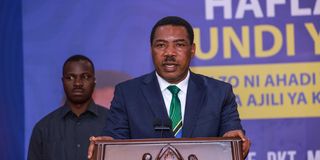
Dar es Salaam. While the government has issued a Sh200 billion cheque to empower youth and women economically, Prime Minister Dr Mwigulu Nchemba said it will take firm action against those practising exploitation and usury through predatory loans.
Dr Mwigulu directed the Minister of State, Prime Minister’s Office – Regional Administration and Local Government (PMO-RALG), Prof Riziki Shemdoe, to instruct regional commissioners to act against individuals exploiting Tanzanians’ hardships to trap them in unfair loan arrangements.
The Prime Minister gave the directive on Thursday, February 5, 2026, in Dodoma during the Sh200 billion cheque handover for the Youth Development Fund, part of President Samia Suluhu Hassan’s pledge to implement initiatives within 100 days of her 2025 election campaign.
On disbursing the funds, Dr Nchemba stressed transparency in the terms of release and urged communities to support the government’s efforts to protect citizens from harsh loan conditions.
“Without clearly explaining the terms, citizens assume street loans have easier conditions than banks. No bank imposes harsh conditions like predatory lenders, yet people rush to them. Even employees of the Bank of Tanzania and government officials are sometimes involved in such loans,” he said.
“The government will continue acting against unofficial lending that harms people, where terms are uncontrolled,” he added.
Dr Mwigulu contrasted bank loans with predatory lending, noting that leniency applies only in official institutions, while predatory loans carry excessive interest and harsh terms. He pledged strict action against such exploitation and usury.
He called on financial institutions to provide education and establish mentoring programmes for borrowers, as many fear consequences such as bankruptcy or loss of assets.
“Tanzanians have suffered greatly in matters of trust. People take loans under harsh conditions, knowing their relative may struggle, and later see their belongings seized,” he said.
To curb this, he said the government will improve loan terms and ensure capital access through official channels, preventing citizens from resorting to exploitative loans that increase poverty.
Benefits for youth
Dr Mwigulu said President Hassan has instructed that youth, women, and people with disabilities previously receiving loans via councils will, by June, receive an additional five percent for infrastructure projects.
“These funds will support markets and business-related infrastructure,” he said.
He stressed that citizen economic empowerment is a government and private-sector programme to ensure full participation in economic activities.
The Prime Minister urged Youth Minister Joel Nanauka, who coordinates the programme, to ensure funds reach beneficiaries through banks.
“Let us deliver these funds via intended programmes. We changed disbursement through councils to avoid ghost groups. President Hassan did not intend for funds to go to ghost groups, as results would not be visible,” he said.
He demanded that ministries’ policies and strategies reflect the goal of economically empowering women and youth.
Policies hindering innovation, entrepreneurship, or access to capital must be reviewed, he said, noting that traditional approaches are insufficient in a rapidly growing population.
“We have been more controllers than enablers. Now, every office and institution must act as enablers to empower programmes,” he said, instructing financial institutions to transparently publicise government empowerment products, including those channelled through banks.
President Samia’s promises
Dr Mwigulu said nearly all of President Hassan’s pledges have been visibly implemented, including 5,000 civil service jobs within 100 days.
Other initiatives include the recruitment of 7,000 science and mathematics teachers and the launch of Universal Health Insurance for selected groups.
He noted the ban on withholding corpses in hospitals.
“The Sh200 billion cheque demonstrates how the sixth-phase government implements promises in action, not just words. It strengthens youth and women’s participation in the national economy and accelerates inclusive, sustainable growth. This adds to ongoing funds for women, youth, and people with disabilities,” he said.
Other measures have enabled youth to engage in productive activities through the Building a Better Tomorrow (BBT) programme.
Economic growth
Minister of State, Prime Minister’s Office (Policy, Parliament, Coordination and Disabilities), Mr William Lukuvi, said President Hassan’s pledges help youth and women access capital.
He said the Sh200 billion will enable youth and women in arts, agriculture, fishing, film, business, industry, transport, and food services to access funds.
“These funds will stimulate economic activity, particularly in peri-urban and rural areas where youth and women face the greatest challenges,” he said.
Mr Lukuvi added that disbursement will observe transparency, accountability, and productivity, ensuring funds are used for intended purposes.
“The Government will strengthen monitoring and evaluation systems to ensure these funds reach women and youth, enabling these groups,” he said.