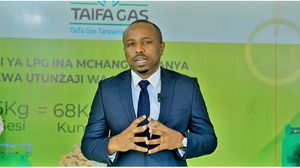
NMB’s Director of Investor Relations, Sustainability, and Corporate Communications, Innocent Yonazi (right) responds to a question during an interview with Mwananchi Communications Limited Executive Editor, Mpoki Thomson, in Dar es Salaam. Photo | The Citizen
NMB has crossed the TZS 1 trillion profit before tax mark for the first time. What fundamentally changed in the Bank’s earnings engine to make this milestone possible, and how sustainable is this level of profitability?
The strategic enablers behind this milestone are our clear commitment to serve Tanzanians and our resolve to pursue a strategy with clarity and purpose.
At the height of Covid-19 in 2020, NMB made a deliberate decision to transform into a purpose-driven and performance-led organisation. It was during this period that we charted a clear strategic direction to transform NMB into a market leader, underpinned by three strategic priorities: delivering winning propositions, driving operational efficiency, and innovating for the future.
The milestones we have achieved over the years are a culmination of how clearly we articulated our strategy, how resilient our business model has become, and how disciplined we have been in execution.
These achievements are ultimately thanks to the millions of Tanzanians who have chosen NMB as their preferred financial services partner, our investors who have entrusted us with their capital, and our partners who continue to walk with us toward this prosperous and historic future.
Just 15 years ago, the entire banking industry’s profit did not exceed Sh1 trillion. Today, NMB Bank alone has surpassed that level. How do you plan to maintain this trajectory, and what key challenges do you anticipate going forward?
When we were developing our 2021–2025 Medium-Term Plan (MTP), our purpose was not to deliver record profits. Our objective was to transform NMB into a purpose-led and performance-driven institution. We believe organisations exist to serve people, and profits are a reflection of how well that service is delivered.
From a sustainability perspective, our growth journey has been robust. We have moved from profitability of around Sh200 billion to Sh750 billion in net profit and Sh1.1 trillion in profit before tax. There has never been a year in which we have not recorded strong growth. This is driven by the quality of our strategy, discipline in execution, and the uniqueness of our business model.
Looking back at the 2021–2025 Medium-Term Plan, which strategic decisions had the biggest impact on performance, and which were the hardest to execute?
At the core of our strategy was deliberate investment in what we refer to as strategic investment areas. The first and most critical was investment in our people. We recognised early that to achieve the milestones we are seeing today, we needed high-quality talent capable of delivering exceptional customer service and executing our strategy with purpose and clarity.
We also invested heavily in technology. We believed that transforming NMB into a digitally led bank was non-negotiable, as digital is the future. Over the past five years, we have invested more than Sh232 billion in our technology infrastructure to build a future-ready and future-proof institution. This has translated into efficiency gains, improved service delivery, and enhanced customer experience. Today, more than 94 percent of our transactions take place outside branches through alternative channels.
Another key investment area was corporate governance. We sought to build a robust governance framework that could cushion the bank against external shocks and global volatility.
We also invested significantly in expanding our agency network to advance financial inclusion. Today, we have over 73,000 agents across Tanzania, serving 9.9 million customer accounts. Over the past five years alone, we have brought more than five million new customers into the formal banking system.
With both net interest income and non-interest income growing strongly, how deliberately has NMB diversified its revenue streams to reduce reliance on traditional lending?
Revenue diversification has been a deliberate strategic priority. We recognised that sustainable growth requires a balanced mix between interest income and non-funded income.
Previously, non-funded income contributed less than 30 percent of total revenue. Today, it contributes over 32–33 percent. Over the years, we have introduced innovative solutions such as the NMB Wrist, products that were previously absent from the market, to enhance convenience and drive transactional volumes.
Why has there been a delayed entry of wearables into Tanzania’s banking industry?
Africa’s payments journey has been very different from that of Europe. Africa leapfrogged the card era and moved directly into mobile payments, unlike Europe, which evolved gradually from cash to cards and then digital payments.
This leapfrogging meant solutions such as “tap and go” were not immediately relevant in Africa’s banking ecosystem. However, the growth of global e-commerce has now created room for such innovations, making wearables increasingly relevant in everyday transactions.
Your cost-to-income ratio of 37 percent signals strong operating leverage. How do you balance aggressive cost discipline with continued investment in technology, people, and innovation?
Clarity of strategy and discipline in execution have been key drivers of these outcomes. NMB enjoys high productivity levels due to the quality of our people, making us one of the most efficient financial institutions in Africa.
At the same time, our continued investment in digital infrastructure has driven further efficiency gains. These investments allow us to scale efficiently while continuing to invest in people and innovation.
NMB’s assets grew by 25 percent to Sh17.2 trillion, while NPLs remain low at 2.5 percent. What risk management principles have supported this rapid but sound growth?
NMB’s growth mirrors Tanzania’s economic trajectory. The country has experienced strong growth, and NMB has positioned itself to leverage opportunities in sectors that sit at the heart of this story, particularly MSMEs and agriculture.
We have also grown strongly in household lending and private sector credit. As a bank of strategic importance, NMB has played a catalytic role in supporting Tanzania’s economic expansion.
On the corporate and wholesale side, we are among the leading financiers in sectors such as mining and manufacturing. On the funding side, customer deposits grew to over Sh14.2 trillion, representing more than 30 percent year-on-year growth.
What strategies do you use to maintain low NPLs while continuing to grow lending?
We place strong emphasis on the quality of origination. We maintain rigorous underwriting standards supported by experienced credit assessors.
In addition, we leverage advanced technology in credit monitoring, enabling early identification of stress and proactive portfolio management.
Over Sh7 trillion has been disbursed to MSMEs and agri-retail customers. How do you measure the real economic impact beyond financial returns?
NMB was established in 1997 to serve the “missing middle”, individuals, MSMEs, and small-scale farmers. This remains central to our mandate.
Over the past five years, we have disbursed Sh28 trillion across various sectors, with an outstanding loan book of Sh10 trillion at the close of MTP 2025. The economic impact is reflected in strong multiplier effects, improved livelihoods, job creation, and inclusive growth, contributing meaningfully to Tanzania’s development.
As one of Tanzania’s most profitable corporates and a major contributor to tax and dividends, how does NMB balance shareholder returns with its broader developmental role?
We operate within a triple bottom line framework, balancing people, planet, and profit.
From a shareholder perspective, profitability enables sustainable returns. Over the past five years, we have paid more than Sh700 billion in dividends.
From a social perspective, NMB plays a central role in Tanzania’s economic and social development. We allocate one percent of our annual profit to corporate social investment initiatives. Over the last MTP, we spent more than Sh23 billion on health, education, environmental stewardship, and youth entrepreneurship.
Tell us about your plans to expand beyond Tanzania’s borders.
Under our 2026–2030 Medium-Term Plan, dubbed Agenda 2030, regional expansion is a key strategic intent. We will continue to take a prudent and disciplined approach to growth, with inorganic expansion forming part of our next growth frontier.
Register to begin your journey to our premium contentSubscribe for full access to premium content