From primary school leaver to 'street engineer': The rise of Adam Zacharia
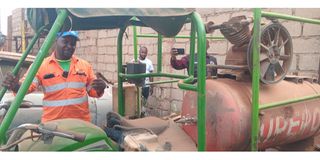
Innovator Adamu Zacharia demonstrates one of his crop-processing machines at his workshop in Mpemba, Tunduma Town, Songwe Region on Tuesday, August 4, 2026. PHOTO | HAWA MATHIAS
Songwe. Hardships in life drove a young man, Mr Adam Zacharia, famously known as ‘Street Engineer’, to create various innovations using scrap metal, manufacturing crop-processing machinery and vehicle spare parts while imparting practical skills to over 200 local youths.
Apart from processing crops, he adds value to agricultural residues, deriving quality animal feed and manufacturing school desks and chairs.
Despite completing only primary education, Mr Zacharia has demonstrated that talent, innovation, and perseverance can transform lives, offering practical solutions to the agricultural and automotive sectors.
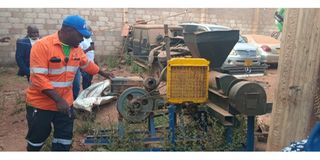
Innovator Adamu Zacharia demonstrates one of his crop-processing machines at his workshop in Mpemba, Tunduma Town, Songwe Region on Tuesday, August 4, 2026. PHOTO | HAWA MATHIAS
A native of Njombe Region who now resides in Mpemba within Tunduma Town Authority, Songwe Region, Mr Zacharia operates his workshop a few metres off the Tanzam Highway connecting Tanzania and Zambia, on the left towards Mbeya Region.
Demonstrating his ingenuity, an improvised helicopter he fabricated several years ago sits outside his workshop.
Although he could not advance the project due to financial constraints, the endeavour brought him immense fame locally and internationally.
Speaking to The Citizen’s sister newspaper Mwananchi on Tuesday, August 4, 2026, Mr Zacharia said he moved to Tunduma in 2002 from Iringa Region in search of a livelihood.
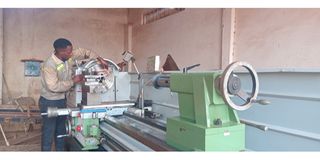
Youth beneficiary Ernest Makanga welds spare parts using advanced machinery provided by the National Commission for Science and Technology (Costech) on Tuesday, August 4, 2026. PHOTO | HAWA MATHIAS
While there, he focused on mechanical work and fabrication, aiming to solve challenges facing local farmers.
He described the journey as arduous, experiencing moments of despair while working under tough conditions with limited capital and relying heavily on manual labour to build machines.
"I started without capital or modern tools. I had only primary education, yet I never stopped believing in my potential," he said.
During initial stages, he manufactured machines using scrap metal, though they lacked refined quality.
However, he persevered until he succeeded, becoming a refuge for residents.
To boost his income, he designed a mobile garage, an innovation that built his confidence and made him widely known within and outside the country.
He said revenue from the mobile garage sustained his livelihood while funding his ongoing efforts to construct crop-processing equipment.
The turning point
His breakthrough came when an official from the Community Development Department saw his diesel-powered, scrap-metal crop processing machine in action on a farm and linked him with development opportunities.
The biggest breakthrough arrived in 2019 when he participated in an innovators' competition organised by the government through the National Commission for Science and Technology (Costech) in Dodoma.
Competing alongside participants ranging from primary school leavers to university graduates, Mr Zacharia represented the informal sector.
"I demonstrated how my innovation addresses farmers' challenges and curbs post-harvest losses. After explaining my constraints, Costech provided me with modern equipment worth Sh94 million. That marked the beginning of a new chapter," he recalled.
Expanding production
Equipped with modern machinery, Mr Zacharia significantly expanded his production capacity, attracting clients from Tanzania, Zambia, and Malawi.
He began manufacturing modern crop-processing units, vehicle spare parts, and industrial components, while offering vocational training to unemployed youths and college students.
His workshop has become a learning hub for students from tertiary institutions nationwide seeking practical exposure.
"I always prayed to contribute meaningfully to national development by solving community challenges, particularly in agriculture. That prayer was answered," he said.
Mr Zacharia has featured in major trade exhibitions across East Africa, broadening his market for automotive spare parts, processing plant machinery, and brick-making machines.
"I take pride in this progress achieved through Costech's support. Without them, I would not be here today, nor would I have been able to empower unemployed youths," he added.
Empowering local youth
More than 200 youths have undergone training at his centre, with many establishing independent workshops.
He noted that these achievements enabled him to pay taxes, generate employment, and boost agricultural productivity by mitigating post-harvest losses.
According to Mr Zacharia, his machines process one tonne of maize within an hour using approximately one litre of diesel, significantly reducing operational costs and time for farmers.
"The objective is not to replace manual labour, but to offer cost-effective technology that minimises crop losses," he explained.
However, financial constraints remain a bottleneck: "Demand is exceptionally high in Songwe and neighbouring Malawi and Zambia, but a cash crunch limits production scaling."
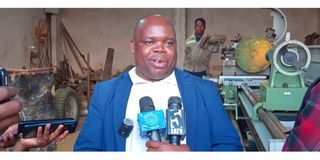
Costech acting director for technology development and transfer, Dr Erasto Mlyuka, speaks to journalists during his visit to the innovator on Tuesday, August 4, 2026. PHOTO | HAWA MATHIAS
He also urged the government to streamline product registration procedures to help local innovators commercialise their equipment easily.
Machine prices currently range between Sh10 million and Sh12 million due to raw material costs, though Mr Zacharia maintains they offer superior durability compared to imported alternatives.
Government support
Costech acting director for technology development and transfer, Dr Erasto Mlyuka, stated that the government allocated over Sh4 billion through the Samia Innovation Fund to support local innovators driving economic growth.
He commended Mr Zacharia's contribution, noting that Costech partnered with the Dar es Salaam Institute of Technology (DIT) Songwe campus to refine his fabrications to international scientific standards.
A mechanic trained at the workshop, Mr Ernest Makanga, said the skills acquired enabled him to design equipment independently, including gold processing machinery, reducing reliance on imported spare parts.