Funding: African leaders urge self-reliance on infrastructure
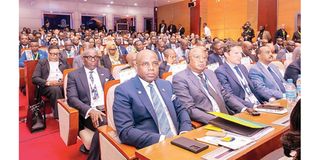
Delegates attend the 2026 Infra for Africa Forum and the Africa50 General Shareholders Meeting at the Julius Nyerere International Convention Centre in Dar es Salaam yesterday. The conference was opened by President Samia Suluhu Hassan. PHOTO | STATE HOUSE
Dar es Salaam. African leaders and top policy-makers have made a resounding call for the continent to pivot towards strategic domestic resource mobilisation and self-reliance to bridge the staggering $100 billion annual infrastructure financing gap.
They made the call yesterday during the 2026 Infra for Africa Forum and the Africa50 General Shareholders Meeting in Dar es Salaam.
They argued that the era of relying on external aid is waning, necessitating a new era of African capital for African infrastructure.
Opening the meeting, President Samia Suluhu Hassan emphasised that Africa’s transformation will only be sustainable if it is funded and led by Africans themselves.
She noted that whilst the continent has historically been rich in vision, the current decade must be defined by the “speed and scale” of delivery.
“Clearly, Africa has never lacked visions. Through Agenda 2063, the African Continental Free Trade Area and our national development plans, we have set ambitious goals. Our priority now has to be pivoted towards delivery,” President Hassan said.
“Our people measure progress not by the declarations we make, but by visible outcomes such as roads, reliable energy, efficient ports and digital connectivity that create jobs.”
On the global financial landscape, President Hassan noted that heightened uncertainties, ranging from geopolitical tensions to climate change, reinforce the need for self-sustaining economies.
“These realities reinforce the need for Africa to build resilience and self-sustaining economies by adding value to our resources, strengthening regional value chains, expanding intra-African trade and mobilising domestic capital for our own development.”
Furthermore, President Hassan highlighted Tanzania’s roadmap, Development Vision 2050, which places the private sector at the heart of the nation’s 25-year growth strategy.
“Our journey to 2050 places the private sector at the centre of economic growth, with the ambition that 70 percent of economic contribution will be driven by the private sector, locally and globally,” she said.
According to her, Africa was no longer merely a source of raw materials, but a destination for value addition. “Tanzania stands ready to work with Africa50, governments, investors and development partners to accelerate delivery of infrastructure that connects our people and industries.”
Kenya’s Deputy President, Prof Kithure Kindiki, who represented President William Ruto, brought a practical perspective on the “policy disruptions” that often stall large-scale projects.
He said for Africa to thrive, its development agenda must be insulated from the volatility of democratic cycles.
“The biggest threat today to Africa’s development is policy disruption, an unintended consequence of democracy,” warned Prof Kindiki.
“We must find ways of insulating our development agenda from democratic transitions so that a project remains in place for 30, 40, or 50 years regardless of who is in power.”
Prod Kindiki said Africa must build “confidence in itself” to achieve what other continents have managed.
The African Development Bank Group President and Chair of Africa50, Dr Sidi Ould Tah, provided a sobering look at the continent’s financing needs.
He noted that whilst the financing gap remains vast, the solution lies within Africa’s own vaults.
“Africa possesses an estimated $4 trillion in domestic institutional capital through pension funds, sovereign wealth funds and insurance companies. Yet, only a small share is invested in infrastructure,” Dr Ould Tah said.
“This is why the new African Financial Architecture for Development (NAFAD) matters, to connect African savings to African transformation.”
The forum also highlighted the strategic importance of natural gas as a transition fuel for industrialisation.
Mozambique’s Finance Minister, Ms Carla Louveira, shared her country’s model of using a sovereign wealth fund to ensure intergenerational equity.
“We created a sovereign wealth fund where 40 percent of LNG (liquefied natural gas) revenues go into the fund for future generations and 60 percent is used to finance the budget for industrialisation,” she said and stressed that the pattern of exporting raw materials whilst importing manufactured goods must change.
This sentiment was echoed by Nigeria’s Minister of State for Petroleum Resources, Mr Ekperikpe Ekpo, who introduced the mantra of “gas to prosperity”.
“For too long, we have exported our crude whilst over 600 million Africans lack access to electricity. The time has passed for us to continue to talk about exporting our natural resources; rather, we should use them and develop our continent,” he said.
Senegal’s Energy and Petroleum Minister, Dr El Hadji Abdourahmane Diouf, emphasised that energy must serve as the foundation for “million-dollar industries” through intelligent transitions.
On the local front, Tanzania’s Energy Minister, Mr Deogratius Ndejembi, highlighted the urgency of clean cooking, stressing that it is no longer a topic that needs to take time; rather, it is an urgent development priority.
He called for regional pipelines, noting: “We need pipelines from Tanzania to Kenya, Uganda and the Democratic Republic of Congo to scale up access to LPG and CNG (compressed natural gas).”
Tanzania’s Finance Minister, Mr Khamis Mussa Omar, said the country’s 2023 decision to become a shareholder in Africa50 was a vote of confidence in African-led solutions.
“We recognise that modern transport networks, reliable energy and digital connectivity are essential to promoting industrialisation,” he stated.
The African Continental Free Trade Area (AfCFTA) Secretary-General, Mr Wamkele Mene, underscored that a single market of 1.4 billion people cannot function without world-class infrastructure.
“Fiscal issues and reduced aid constrain the global context. We must mobilise our own capital. Our role is to deploy trade rules that create investor confidence and enable domestic production to reach regional markets,” he said.
Register to begin your journey to our premium contentSubscribe for full access to premium content