The then-President, Julius Nyerere, encouraged Pan-African solidarity and welcomed members of the African diaspora, particularly those involved in liberation struggles.
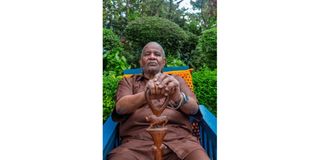
Dar es Salaam. An American political activist and former chairman of the Kansas City chapter of the Black Panther Party, Mr Felix “Pete” O’Neal Jr., has spent over five decades building a life of community service in Tanzania.
The Black Panther Party was a Black liberation organisation active in the United States during the late 1960s and early 1970s.
O’Neal rose to prominence by leading community programmes in Kansas City that addressed poverty, hunger, and systemic racism.
Under his leadership, the chapter ran free breakfast programmes for children, medical clinics, clothing drives, and campaigns against slum housing conditions and police brutality.
The Black Panthers also sought to educate residents about economic inequality and civil rights.
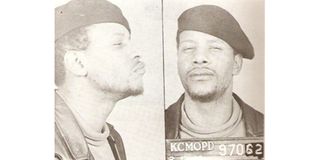
On October 30, 1969, O’Neal was arrested on a federal firearms charge for transporting a shotgun across state lines, under a law that had only recently been enacted.
Pete O’Neal in Kansas City Police Department Mug shot in 1969
Convicted and sentenced to four years in prison in October 1970, he chose to jump bail and leave the United States rather than serve the sentence.
Many supporters have described the charges as politically motivated, linked to the United States Federal Bureau of Investigation (FBI’s) COINTELPRO programme, aimed to disrupt and dismantle black activist groups.
While living as a fugitive, O’Neal first travelled to Algeria, where several Black Panther members operated within the party’s “International Section”.
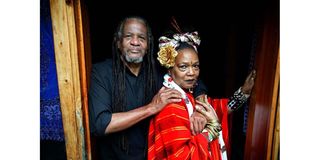
A year later, in 1972, he moved with his wife, Charlotte Hill O’Neal, to Tanzania.
The then-President, Julius Nyerere, encouraged Pan-African solidarity and welcomed members of the African diaspora, particularly those involved in liberation struggles.
Settling in Imbaseni village in Arusha, the O’Neals began a self-sufficient rural life.
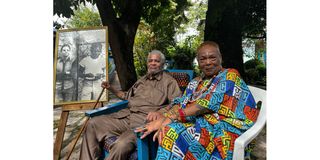
Pete O’Neal and his wife, Charlotte Hill O’Neal, reflect on shared memories of Sekou Odinga as they stand with his portrait—recounting their time together in Algiers at the International Section of the Black Panther Party in the early 1970s, ahead of an upcoming tribute celebration.
They farmed, built their own home, raised livestock, cultivated crops, and constructed windmills, gradually earning acceptance and respect in the local community.
In 1991, they formally founded the United African Alliance Community Center (UAACC), a non-profit grassroots organisation dedicated to education, culture, and community empowerment.
The centre grew from the O’Neals’ longstanding commitment to service and Pan-African ideals.
Its programmes include free classes in English, sewing, art, music, yoga, video production, and computing, aimed at equipping young people with practical skills, cultural pride, and confidence.
The centre routinely hosts free classes for local youth and serves as a cultural hub for creative and vocational training.
Over the years, the UAACC expanded to include a fully equipped computer lab, art studios, and community spaces.
It also hosts visiting students, volunteers, and practitioners from around the world.
Former Black Panther members and international supporters have contributed to the centre’s programmes, with artists and educators leading workshops and classes.
Beyond education and arts programmes, the UAACC has completed major community infrastructure projects.
With support from fellow former Panther Geronimo Ji Jaga Pratt, the O’Neals drilled a well providing fresh water to the village and later helped install electricity poles, electrifying the surrounding area.
Geronimo ji-Jaga
In 2008, they established the Leaders of Tomorrow Children’s Home, which provides housing, education, and healthcare for disadvantaged children, integrating them into family life alongside their own children.
Pete and Charlotte’s life in Tanzania reflects a long-term commitment to community building that extends the Black Panther Party’s original emphasis on mutual aid and self-determination into a global context.
Although decades have passed since he departed from the United States, O’Neal has not returned, partly because he would face imprisonment if he did.
Their story has been documented in films such as A Panther in Africa, tracing their journey from the United States to East Africa, and exploring the challenges of political exile and identity.
For more than fifty years, their work in Tanzania has shaped generations of youth, linking the struggle for social justice in America with grassroots empowerment on African soil.