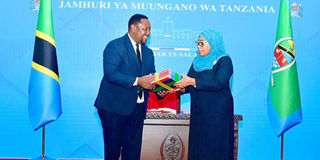
President Samia Suluhu Hassan receives the Annual Performance Report of the Public Procurement Regulatory Authority (PPRA) from the Authority’s director general, Mr Dennis Simba, at State House in Dar es Salaam on March 30, 2026. PHOTO | COURTESY
Dar es Salaam. Tanzania’s drive to digitise public procurement is beginning to show tangible results, with institutions reportedly saving Sh13.3 billion in a single financial year and achieving combined financial and environmental gains exceeding Sh35 billion over two years—evidence that technology can curb wasteful spending in government systems.
These achievements stem directly from the National e-Procurement System (NEST), which has streamlined tender processes, boosted competition, and strengthened transparency across government procurement.
Beyond cutting paper use, an estimated 6,768 tonnes avoided, NEST also reduced supplier travel by over 15.4 million kilometres, saving around 1.7 million litres of fuel and more than Sh3.2 billion in transport costs.
A March 11, 2026 PPRA performance assessment covering 2023/24 and 2024/25 reported that over 219,000 tenders were processed through NEST, avoiding roughly 288.57 million pages of documents, equivalent to 577,000 reams of paper and nearly 76,000 toner cartridges, and saving an additional Sh27.64 billion in paper and toner costs.
Compliance with procurement laws also improved. In the 2024/25 financial year, compliance rose to 79 percent, up from 76 percent the previous year, reflecting the enforcement of the 2023 Public Procurement Act and the expanded use of NEST.
“In the 2024/25 financial year, compliance with procurement laws increased from 76 percent to 79 percent, reflecting the impact of the 2023 Public Procurement Act and the rollout of NEST,” said PPRA director general, Denis Simba, during the presentation to President Samia Suluhu Hassan at the State House on Monday (March 30, 2026).
Procurement activity has also expanded. Nearly 100,000 tenders were advertised in 2024/25, a 72 percent increase from 53,221 the previous year, while participation almost doubled, from 11,564 to 22,913 bidders.
“The growing number of tenders and participants is a clear signal that NEST is opening procurement to more players and strengthening transparency,” Mr Simba added.
Experts react
Experts highlight the system’s wider impact. University of Dar es Salaam procurement specialist Oliva Mwambafula said digital procurement platforms like NEST are not only about speed. He said they provide accountability by creating audit trails and reducing opportunities for human interference in tendering processes.
A procurement expert who also lectures at the College of Business Education, (CBE), Alfred Assenga, said the integration of lower-level entities, such as schools and health centres, ensures that compliance extends beyond central ministries.
“This is crucial for curbing mismanagement at grassroots levels,” he noted. Indeed, more than 6,900 lower-level entities now actively use NEST. New modules for contract management, complaints handling, and local procurement have strengthened oversight.
Economists also see broader benefits. An economist and Fiscal policy expert, Mr Samson Rutashobya, from the University of Iringa said NEST promotes economic inclusion by ensuring that youth and women have equitable access to government contracts.
“It also stimulates local production by prioritising domestic suppliers,” he said.
Challenges remain
The PPRA report revealed that 756 out of 943 procuring entities failed to allocate the required 30 percent of procurement budgets to special groups. Off-system procurement continues, with payments for unexecuted work totalling Sh11.6 billion.
ICT expert and CEO of Sartify, Dr Michael Mollel, emphasised technology’s role in bridging gaps: “NEST’s integration with 21 government systems, coupled with real-time dashboards, AI, and data analytics, provides the government with a robust toolkit to detect anomalies early and enforce compliance.”
Inclusivity has also improved. In 2024/25, Sh9.1 trillion of Sh14.5 trillion total procurement was awarded to youth, women, and other special groups, representing 62 percent of total value. Contracts for these groups rose from Sh6.1 billion in 2023/24 to Sh11.3 billion.
PPRA’s value-for-money audits of 481 contracts showed 58 percent achieved intended outcomes, 34 percent fell short, and 8 percent underperformed significantly. Contract monitoring is now strengthened, with NEST tracking completion in real time.
“These reforms aim to create a culture of transparency, accountability, and efficiency in public funds use. With NEST, Tanzania is moving towards a public procurement system that is both transparent and resilient against waste and corruption,” Mr Simba said.