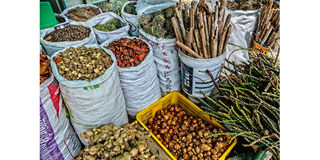
Dar es Salaam. From forest roots harvested hundreds of kilometres away to neatly arranged powders and bottled remedies lining shop shelves in busy neighbourhoods, the traditional medicine supply chain feeding Dar es Salaam operates through an expansive but largely informal network that stretches the city’s regulatory capacity.
At its core are raw materials sourced mainly from within the country. Sellers and shop owners say the origin of medicines depends on the type of remedy being prepared, with Morogoro, Arusha, Manyara and Zanzibar among the leading sources. These regions are prized for their biodiversity and long-standing herbal traditions.
While the network appears informal on the streets of Dar es Salaam, it is governed by strict legal mandates designed to protect public health.
According to the Traditional and Alternative Medicines Act, Cap 244 (2023 Revision), the primary regulatory authority is the Traditional and Alternative Health Practice Council (TAHPC). The law provides a framework to promote, control and regulate the sector, ensuring that every remedy, from forest to shelf, is scrutinised for safety.
Section 30 of the Act explicitly prohibits any traditional practice likely to endanger patients, placing public safety above commercial interests.
Product registration is central to the regulatory framework. Regulation 11 of the Traditional and Alternative Medicine (Registration of Medicines) Regulations, 2008, states that no medicine may be used unless it is registered, except in emergencies. All products must undergo toxicological analysis by the Government Chemist Laboratory Authority (GCLA) before approval. Retail and distribution are also regulated. The Third Schedule empowers the Council to manage marketing, practitioner-level remedies and ensure that sales occur only in authorised locations. The President’s Office–Regional Administration and Local Government (PO-RALG) monitors retail facilities at the local level, while compliance with current Good Manufacturing Practices (cGMP) is required to ensure hygienic production and consistent potency.
On the ground, however, the reality often diverges sharply from the legal framework.
“You will find that many herbs arrive here as powders, tree bark or roots. We then package them according to customer demand and in a way that allows us to make a profit,” said Abdallah Rashid, proprietor of Herbal Care Supplies in Kariakoo.
Other sellers explained that not all products are processed at shop level. Some arrive already packaged from traders who specialise in preparation.
“There are medicines we buy from other sellers that are already packed. Those ones come ready for sale, while others we prepare ourselves depending on what the client needs,” said a seller in Buguruni, Faudhia Salum.
Knowledge of which remedy treats which ailment is often drawn from books, inherited knowledge and practical experience.
“We use books a lot to understand what each medicine is used for. But experience also helps you understand many medicines better over time,” said owner of Ndola Herbal Centre in Mbagala, Hamisi Ndola. Most sellers say they do not diagnose clients. “We do not examine patients. A person comes already knowing what they are suffering from, and our role is to give them the medicine that matches that problem,” Ms Salum said.
“Many customers come with knowledge of their ailment, and we focus on guiding them to the right remedy based on our experience and training,” added a proprietor of Afya Asili Centre in Mbagala, Jongo Omary.
Rehema Mkinga, who runs Uhai Herbal Solutions in Manzese, said trust is built through direct interaction.
“Even when the shop is busy, we take time to ensure clients leave with the right medicine. That builds trust,” she said.
Beyond physical shops, a growing layer of informal digital agents is quietly linking sellers to customers through social media, earning commissions of between five and 12 percent per sale.
College student Jackline Shayo, 20, said she sells mainly skin-related products and remedies targeting intimate health concerns.
“The prices usually range from Sh12,000 to Sh90,000, depending on the product and the severity of the problem,” she said.
“This work is simple because all you need is a phone and internet access. Once a sale is completed, I receive between five and ten percent of the profit, depending on the price and the agreement with the seller,” she added.
Another online agent, 22-year-old Nickson Silla, said products related to male sexual performance are among the fastest-moving.
“Prices range from Sh35,000 to as high as Sh320,000, depending on how long the client has had the problem. Online engagement offers privacy and avoids embarrassment, which many customers prefer,” he said.
This informal digital layer reflects the broader complexity of the traditional medicine supply chain. According to the Diagnostic Study on the Application of Herbal and Traditional Medicine, 2021, issued by the East African Community (EAC) and GIZ, the chain begins with wild harvesting—collecting roots, bark and leaves directly from natural ecosystems.
Tanzania’s extensive forest resources make this the dominant source, but the practice raises sustainability and safety concerns.
The Ministry of Health, through the National Traditional and Alternative Medicine Strategic Plan I, 2016, warns that reliance on wild harvesting is unsustainable and calls for the establishment of medicinal plant farms to ensure a consistent and safe supply.
Yet much of Dar es Salaam’s sourcing still depends on informal networks that are difficult to trace and regulate. Once harvested, materials move into wholesale and processing stages that remain largely opaque. The Performance Audit Report on the Regulation of Traditional and Alternative Medicine, 2024 notes that all registered medicines must undergo GCLA toxicological analysis before sale.
However, out of 499 medicines sampled in the market, only eight were registered, suggesting that most products bypass formal safety checks.
Retail is the most visible segment of the chain, ranging from street vendors to specialised herbal shops in high-traffic areas. The EAC–GIZ 2021 study notes that remedies now appear on supermarket shelves, and outlets have even been established within hospitals, reflecting the sector’s growing commercialisation.
Despite this expansion, regulatory gaps remain. Many retailers and small-scale processors lack training in Good Manufacturing Practices, leading to inconsistent quality. Potency and safety can vary significantly between batches, even under the same brand.
Ministry of Health data show that Tanzania exports more than 30 tonnes of traditional medicine annually, generating about $200,000. While this indicates growing commercial potential, much of the value chain remains under-regulated, with profit sometimes outweighing safety protocols.
The Ministry acknowledges these challenges but says oversight continues.
Acting Assistant Director in the Directorate of Curative Services, Dr Winifrida Kidima, said the Council conducts both active and passive surveillance each year.
“The council still faces challenges related to resources; however, supervision and inspections continue to be conducted annually,” she said.
During the 2024/25 financial year, the ministry focused more on education than confiscation.
“There were no traditional medicines confiscated or cancelled. Instead, the council focused on educating stakeholders on how to comply with the law and relevant guidelines,” she added.
The Ministry, through the Traditional Medicine Council, is currently collaborating with the Regional Medical Officer’s office to register traditional healers in Dar es Salaam.
The registration exercise is being conducted from February 9 to 20, 2026, at Mkunguni Street in the city.
Exercise coordinator Lucy Laurian said the aim was to ensure all practitioners operate in accordance with legal requirements.
“We urge all traditional medicine practitioners to turn up in large numbers to register so that they can obtain valid licences to provide services. Under the Traditional and Alternative Medicine Act, Chapter 244 of the Laws of Tanzania, it is an offence to provide services without registration,” she said.
She added that the law empowers the Registrar and the Council to take legal action against violators, including imposing fines or other penalties.
The Ministry says the exercise is part of broader efforts to formalise the sector and ensure citizens receive safe, standardised and legally recognised care.
At the Muhimbili University of Health and Allied Sciences (Muhas), researchers say bridging the gap between regulation and market reality requires strengthening technical capacity across the supply chain.
Dr Benson Mugaka, a researcher at the Institute of Traditional Medicine, said one of the biggest challenges is the entry of sellers with limited expertise as the sector becomes more commercialised.
“Even if there are families of highly skilled traditional healers, once the business grows, everyone enters the sector. That is where the challenges begin,” he said.
In response, Muhas has introduced short-term training programmes at three levels, covering production principles, legal requirements, registration processes, safe packaging and quality standards.
Improving technical knowledge among those involved in the supply chain, researchers say, will be critical to reducing health risks for users in Dar es Salaam.
Register to begin your journey to our premium contentSubscribe for full access to premium content