Human rights judges warn force is replacing law worldwide
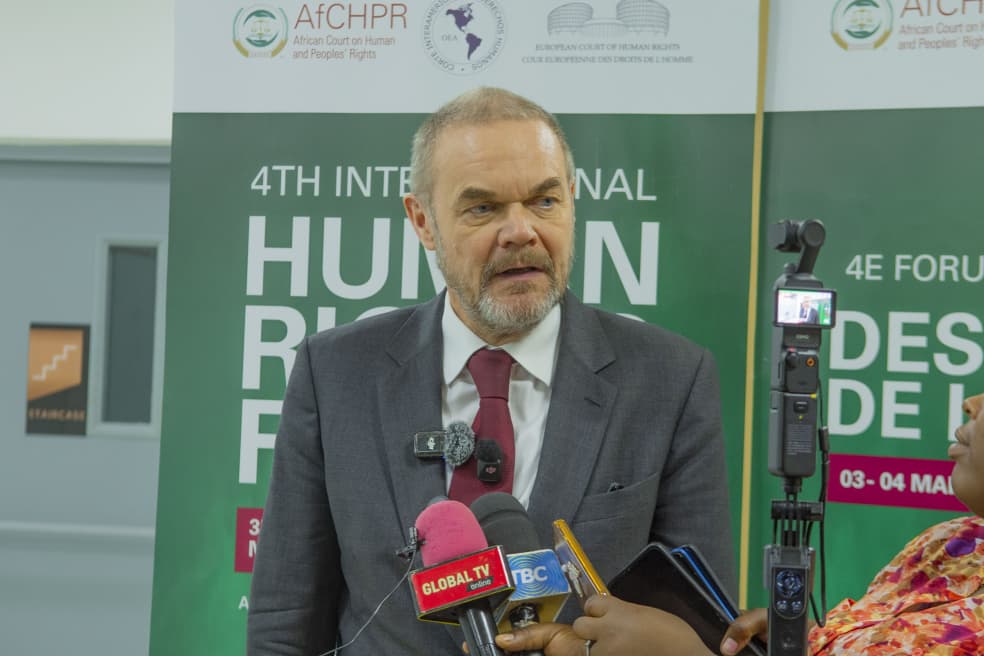
European Court of Human Rights Vice President Judge Arnfinn Bardsen addresses journalists during the Fourth International Human Rights Forum under way in Arusha on Wednesday, March 4, 2026. PHOTO | BERTHA ISMAIL
Three human rights courts from Africa, Europe, and the Americas have raised concern over the global increase in the use of force, warning that it undermines the rule of law and erodes the foundations of democracy
Arusha. Three human rights courts from Africa, Europe, and the Americas have raised concern over the global increase in the use of force, warning that it undermines the rule of law and erodes the foundations of democracy.
Speaking at the Fourth International Human Rights Forum on March 4, 2026, currently underway in Arusha, experts highlighted troubling trends worldwide.
“We are witnessing what we call democratic backsliding. Confidence in democracy is declining while coercive power is on the rise, an extremely dangerous development,” said the European Court of Human Rights (ECHR), Vice President, Judge Arnfinn Bardsen.
Judge Bardsen said the rise in force coincides with the erosion of legal governance, declining trust in judicial institutions, and a weakening of the fundamental principle that societies, both international and national, should be governed by law rather than power.
“Democracy and respect for the law are under immense pressure. We are witnessing excessive use of force by authorities originally established to ensure peace,” he said.
He added that courts and human rights defenders must act decisively to safeguard accountability and legal legitimacy.
Citing major global conflicts, including Israel’s war with Hamas in the Middle East, Russia’s invasion of Ukraine, and escalating tensions between the United States-Israel and Iran, Judge Bardsen pointed to growing concern over the balance between force, self-restraint, and respect for international law.
The forum brought together senior judges and legal experts from Africa, Europe, and the Americas to discuss challenges facing justice systems worldwide and the role of international courts in upholding the rule of law and protecting human rights.
The Inter-American Court of Human Rights (IACHR) Judge Nancy Hernandez Lopez said the world is at a critical juncture for democracy and the rule of law.
“Even when international courts meet in Tanzania to discuss shared concerns, trust in global cooperation is declining,” she said.
She warned that some states remain focused solely on national interests, even as many contemporary challenges transcend borders.
Judge Lopez underscored that issues such as human rights protection, digital privacy, and freedom of communication cross national boundaries, requiring collective international responses rather than purely domestic strategies.
Addressing the forum, the African Court on Human and Peoples’ Rights (AfCHPR) President, Judge Blaise Tchikaya, reaffirmed the responsibility of courts to protect ordinary citizens from the consequences of international unrest.
“In times of conflict and uncertainty, courts must remain steadfast guardians of rights and the rule of law,” he said, emphasising the ethical and legal duty of judicial institutions to uphold human dignity even amid turmoil.
Held biennially among the three regional courts, the forum provides a platform for exchanging experiences, strengthening institutional cooperation, and discussing emerging human rights issues.
Previous editions were hosted in Kampala (2019), Strasbourg (2021), and San José (2023), reflecting growing collaboration.
This year’s discussions also examined the impact of emerging technologies, including artificial intelligence, on governance and human rights, analysing both opportunities and risks.