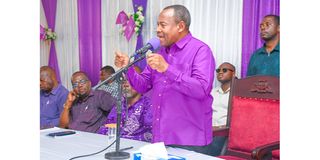
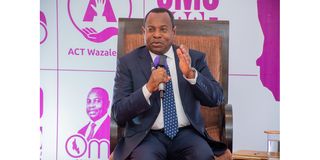
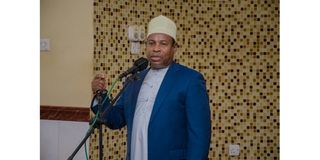
Unguja. Five years have passed since Othman Masoud Othman stepped formally into the political arena.
His entry into politics was through his appointment as the First Vice President of the Revolutionary Government of Zanzibar through the opposition party, ACT Wazalendo on March 1, 2021.
Mr Othman, widely known as OMO, assumed office following the death of Seif Sharif Hamad on February 17, 2021.
The late Hamad was a towering figure in Zanzibar’s opposition politics.
For decades, he shaped debate, defined dissention, and carried the aspirations of those Zanzibaris who sought political reform.
His passing created both a vacuum and a moment of reckoning.
OMO’s appointment marked a turning point in his long career of public service.
This was because until that moment, he had not been an active politician.
He built his reputation within the civil service.
Over a period spanning 25 years, he served as Attorney General of Zanzibar, Permanent Secretary, and Director of Public Prosecutions before he decamped to the opposition.
He was known as a meticulous lawyer and an institutional reformer.
His entry into politics was therefore suprising but not entirely unexpected to many observers.
During the Constituent Assembly that was infinitely suspended in 2014 OMO, then serving as Zanzibar AG took positions that were against the official policy, which caused concerns.
The positions were deemed political and paved the way for his leaving CCM soon after.
Today, he also serves as national chairman of the opposition party, ACT Wazalendo.
Five years into his tenure as First Vice President, he now reflects on a journey he describes as demanding, instructive and deeply personal.
Speaking in an exclusive interview with Mwananchi, sister newspaper to The Citizen, Mr Othman said his transition from legal adviser to political leader reshaped his understanding of public life.
“This journey has been one of learning, resilience and service,” he said.
“I have seen governance from two different sides. As a lawyer, you advise. As a political leader, you decide and carry the consequences.”
He credits the late Hamad with laying the groundwork for political stability in Zanzibar.
According to him, maintaining that stability has been among his foremost responsibilities.
He believes the islands have avoided regression during a delicate period.
Mr Othman insists he did not pursue politics out of ambition.
He describes his appointment as a response to what he calls a historical call.
Following Hamad’s death, he said, colleagues within the opposition sought a figure with deep institutional knowledge who could step into a complex constitutional role.
“I did not consider myself the best,” he said.
“But I accepted out of duty and love for Zanzibar. Real change requires commitment to constitutional principles, even when the cost is personal.”
He says he has no regrets about that decision.
Reflecting on the contrast between public service and politics, Mr Othman draws a clear distinction.
In public service, he explains, one works within established rules.
The role is technical. It demands precision and adherence to procedure. Policy direction is set elsewhere.
Politics, however, operates in a different realm.
It is shaped by public expectation and competing visions.
It requires negotiation and persuasion.
It demands the ability to manage disagreement without deepening division.
“In public service, I influenced from behind the scenes,” he said.
“In politics, my voice is direct. It carries weight in public debate.”
He points to several institutions he helped establish during his civil service career.
These include the Ministry of Constitution and Good Governance, the Zanzibar Revenue Board, the Office of the Director of Public Prosecutions and the Public Service College.
He regards these as structural contributions that continue to shape governance.
As First Vice President, his constitutional mandate is defined.
He serves as principal adviser to the President and participates in executive decision-making.
He may represent the Head of State at official functions.
Yet he acknowledges limitations within the system.
“In the early period, consultation was not always comprehensive,” he said, in an apparent reference to internal dynamics within the Government of National Unity (GNU).
Over time, he believes the culture of engagement has improved, though challenges remain.
Environmental policy has been a significant focus. Zanzibar, as an island territory, faces acute climate vulnerability.
Mr Othman says his office prioritised sustainable resource management.
He founded the Zanzibar Green Legacy programme, aimed at expanding tree planting and strengthening conservation awareness.
He also frames unity-building as a central achievement.
The GNU, established after the 2020 elections, was designed to temper decades of political tension.
For Mr Othman, its value lies less in electoral arithmetic and more in its symbolic reassurance.
“GNU was meant to help Zanzibar move beyond politically created strife,” he said.
“It must be anchored in free and fair elections. It should serve reconciliation.”
He concedes that implementation has not been smooth.
Attempts to deepen cooperation have sometimes met resistance.
Nevertheless, he argues that the arrangement has preserved peace and enabled opposition participation in governance.
On democratic reform, his tone becomes more cautious.
He expresses concern that systemic change has lagged behind public expectation.
Multiparty politics exists.
Yet, he suggests, elements of authoritarian practice and corruption persist.
“I wish reform were faster,” he said.
“The system is not fully structured for competitive politics. Meaningful change requires political will.”
Dialogue with the ruling party, Chama Cha Mapinduzi (CCM), continues.
According to Mr Othman, discussions have covered constitutional review, the Electoral Commission, electoral laws, human rights and accountability. Progress, he admits, has been limited.
“Dialogue is a process,” he observed.
“It is not an event. But it must yield tangible reforms before elections if trust is to deepen.”
Despite these frustrations, he maintains a forward-looking outlook.
He envisions a Zanzibar with strengthened autonomy within the Union framework, a diversified economy and a political culture grounded in ideas rather than grievance.
He draws particular encouragement from young people. In his view, a generational shift is under way.
Youth engagement, he believes, is increasingly issue-based and less defined by historical animosity.
Asked about hope, he pauses before answering. “Hope remains,” he says quietly.
“It is visible in the determination of citizens who demand accountability but reject violence.”
His closing message carries a tone of resolve. To colleagues in ACT Wazalendo, he urges patience and endurance.
“The struggle for justice is a marathon,” he said. “It requires discipline.”
To Zanzibaris more broadly, he appeals for balance. Safeguard peace, he says, while insisting on rights. Unity, in his words, is the islands’ shield.
Five years after entering politics, Othman Masoud Othman stands at an intersection of law and leadership.
His record invites both scrutiny and reflection. For supporters, he embodies continuity and restraint in a fragile landscape.
For critics, he represents the slow pace of reform. For himself, the journey remains unfinished.
Register to begin your journey to our premium contentSubscribe for full access to premium content