Inside Tanzania’s plan to restore 470,000 hectares of lost forests

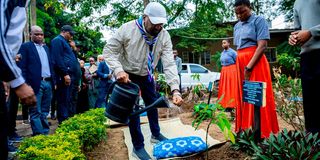
The Minister of State in the Vice President’s Office (Union and Environment), Hamad Yussuf Masauni, participates in tree-planting activities as part of the World Environment Day celebrations, which will culminate on June 5, 2026. PHOTO | COURTESY

Arusha. The government has unveiled an ambitious plan to restore the country’s declining forest cover through a nationwide tree-planting campaign aimed at planting two million trees annually across various regions.

The initiative seeks to reverse the loss of natural vegetation, restore greenery and strengthen the country’s resilience against climate change impacts such as rising temperatures, prolonged droughts, changing rainfall patterns and other environmental shocks.

According to statistics from the Tanzania Forest Services (TFS), the country loses an estimated 469,000 hectares of forest and woodland annually.

The alarming rate of deforestation, largely driven by unsustainable agricultural expansion, livestock grazing and illegal logging, places Tanzania among the countries most affected by forest loss globally.

While the government’s target of planting two million trees annually marks a significant step, the scale of the challenge remains considerable.

At the current pace, the programme would restore only about 2,000 hectares each year, meaning it could take decades to significantly reduce the country’s forest deficit unless the initiative is expanded further.

Speaking in Arusha on May 22, 2026, the Minister of State in the Vice President’s Office (Union and Environment), Hamad Yussuf Masauni, called on the private sector and public institutions to actively support nationwide tree-planting efforts.

Masauni made the remarks after participating in tree-planting activities at Arusha Secondary School, where he also joined a citywide clean-up exercise.

The activities form part of preparations for the upcoming World Environment Day, scheduled for June 5, 2026.

“The tree-planting programme is part of implementing a national strategic environmental transformation initiative that will soon be officially launched,” said Masauni.

“It will guide the country’s vision for conservation and environmental environmental restoration by encouraging citizens to plant trees at their homes and workplaces, while institutions take responsibility for greening public spaces and communities,” he added.

He said the government was also intensifying public awareness campaigns on tree planting, environmental conservation and the protection of water sources.

According to him, the awareness drive will also introduce citizens to emerging opportunities in carbon trading, enabling communities to benefit economically while protecting the environment.

“We are also educating the public about carbon trading opportunities so that people can benefit financially while contributing to environmental conservation and increased tree planting,” he said.

Arusha Regional Administrative Secretary Toba Nguvila said the region was prioritising environmental education as part of broader efforts to promote sustainability and attract tourists.

"This initiative helps us tackle climate change challenges, especially droughts and floods, while also making Arusha more attractive to tourists who may choose to stay longer and visit other destinations,” he said.

Students at Arusha Secondary School welcomed the initiative, expressing optimism about the benefits of increased tree planting within the school environment.

Form Three student Emmy William said the trees would not only improve learning conditions but also support students’ wellbeing.

“We will have more shaded areas where we can study quietly outside the classroom. The fruit trees will also provide vitamins and improve our health,” she said.

She said that the school still needed more trees around its gardens and appealed to institutions and stakeholders to continue supporting the school with seedlings.

This year’s World Environment Day celebrations are guided by the theme “Dira 2050, Tuwajibike kukijenga” and are expected to culminate in nationwide environmental activities on June 5, 2026.