Inside the trade in FGM body parts linked to fishing success
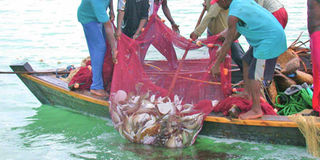
Fishers operating on Lake Victoria bring their catch ashore. Some fishers in Mara Region believe that using body parts obtained from female genital mutilation attracts larger catches and shields them from misfortune. PHOTO | FILE
Mara. Female genital parts extracted during female genital mutilation (FGM) are secretly traded like illicit drugs in parts of the Mara Region, an investigation by The Citizen has established.
This newspaper conducted an undercover investigation in Butiama, Musoma Urban, Tarime and Serengeti districts towards the end of 2025 to establish whether genital parts removed during FGM were being sold, as alleged by local sources.
During the three-month investigation, The Citizen strictly followed professional and legal procedures and established that it could have purchased the genital parts had it chosen to proceed.
However, the transaction was cancelled after the newspaper confirmed that the illegal trade was indeed taking place.
The investigation revealed that genital parts extracted from a single victim are sold at negotiable prices starting from Sh1 million, making the trade among the most lucrative underground businesses in the region.
Traditional leaders and FGM practitioners, locally known as ngaribas, are accused of supplying the parts to fishing boat owners.
The fishers reportedly believe that using the body parts during fishing rituals attracts larger catches and shields them from misfortune.
Despite the existence of multiple laws outlawing FGM and the trade in human body parts, the practice persists, largely due to weak enforcement of regulations, including Section 118 of the Law of the Child Act, Cap 13 of 2019 and Sections 21, 22 and 169A of the Penal Code, Cap 16.
Section 118 of the Law of the Child Act explicitly prohibits the exploitation of children for any purpose, including the illegal trade in organs and body parts. Section 169A of the Penal Code, as amended in 2022, criminalises FGM against girls of any age.
Sections 21 and 22 of the Penal Code further stipulate that remaining silent, failing to report, or neglecting to take action against criminal offences amounts to participation in the crime.
Under the Local Government Acts, Cap 287 and 288, local government authorities, village executive officers and neighbourhood leaders are legally mandated to protect children’s rights within their jurisdictions, as outlined in Sections 142 and 143.
As a result of continued violations, girls subjected to FGM face life-threatening risks, including severe physical injury, psychological trauma and, in extreme cases, death.
To investigate the alleged trade, The Citizen travelled to Musoma District in the region and quickly realised that confirming the existence of the business would be nearly impossible without engaging local networks familiar with the underground operations.
The newspaper, therefore, sought the assistance of a local individual well known in the area and connected to fishing communities.
Initially, the individual was visibly shocked by the inquiry. However, rather than dismissing the allegations outright, the person sought clarification on the origin of the rumours.
The individual cautioned that the task would be extremely difficult and dangerous, requiring patience, emotional restraint and considerable time to gain trust.
According to the source, successful infiltration would require blending in and building credibility with fishing boat owners, described as key players in the trade.
The source advised this newspaper to present itself as a prospective investor interested in operating fishing boats and establishing a fish-processing facility in the region.
After agreeing on the approach, the parties temporarily parted ways. Later that night, the source contacted the newspaper and suggested meeting an agent who could facilitate contact with a reliable supplier of the genital parts.
It was agreed that the meeting would take place the following morning.
According to the investigator, the meeting was successful and the agent promised to link the newspaper with either a fishing boat owner or fishers involved in the practice.
However, both the agent and potential suppliers expressed caution, noting suspicion towards outsiders, particularly because the trade is dominated by men and tightly controlled networks.
The agent proposed travelling to Kinesi in the outskirts of the district where he claimed the parts could be obtained more easily, as boat owners and fishers in other areas had become increasingly suspicious.
Attempts to reach a fisherman based in Kinesi were initially unsuccessful, prompting the agent to promise follow-up communication with a dealer the following day.
Upon his return, the agent suggested meeting at a local entertainment spot to discuss the matter discreetly.
During the meeting, the agent and a fisherman explained that December was a peak period for the availability of genital parts obtained through FGM. They demanded Sh1 million for the immediate supply of the parts.
The investigator negotiated the price down to Sh700,000, with an agreement that Sh250,000 would be paid in advance and the remaining Sh450,000 upon delivery.
The two explained that the parts are given to fishers during routine fishing activities or mixed with water used to clean boats offshore, a practice believed to enhance fish catches.
After sealing the agreement, the agent and fisherman left, promising to deliver the genital parts the following evening.
At around 8pm the next day, the investigator received a call directing him to meet the suppliers for the handover.
However, the investigator requested a postponement, citing difficulties faced by a colleague in Dar es Salaam who was meant to facilitate the remaining payment through banking channels.
The investigator said the primary objective of confirming the existence of the illegal trade had been achieved and completing the transaction would have served no journalistic or ethical purpose.
Commenting on the revelations, Legal and Human Rights Centre (LHRC) Advocacy and Reforms director Fulgence Massawe said Tanzania’s Anti-Trafficking in Persons Act of 2008 explicitly prohibits the sale and trafficking of human beings and their body parts.
“If such activities are indeed taking place, they constitute serious criminal offences. The law prohibits not only the trafficking of persons but also the trafficking of human organs and body parts,” he said.
Mr Massawe noted that previous cases involving people with albinism demonstrated how anti-trafficking laws apply to crimes involving the trade in body parts.
He added that the Penal Code, together with the Sexual Offences Special Provisions Act, introduced Section 169, which prohibits FGM and prescribes severe penalties for offenders.
The Law of the Child, he said, further protects children from harmful cultural practices, including FGM.
Despite these legal protections, Tanzania remains among the countries where FGM persists, largely due to weak enforcement mechanisms.
Mr Massawe said enforcement challenges stem from competing government priorities and the secretive nature of the practice, which makes detection and prosecution difficult.
At the regional level, he said, the East African Legislative Assembly has made efforts to enact stronger laws aimed at eliminating FGM.
However, enforcement remains problematic, particularly where political leaders are reluctant to confront culturally sensitive issues.
“In the Mara Region, an MP or councillor may avoid addressing the issue for fear of backlash. Traditional leaders wield immense influence, sometimes exceeding that of government authorities. When they decide something should happen, it often does, even if secretly,” he said.
Mr Massawe added that although some cases are reported, FGM continues to be practised even in urban areas such as Dar es Salaam and the Coast Region, largely in secrecy.
Head of the Police Gender Desk in Mara Region Charles Ezekiel dismissed claims that genital parts obtained through FGM are traded in the region.
“That is hearsay. We are not aware of any trade in genital parts. However, the police, working with other stakeholders, will investigate the allegations to establish the truth,” he said.
Mr Ezekiel acknowledged the existence of FGM among some Kurya communities, attributing the practice to deeply entrenched cultural beliefs.
The Director of Child Development at the Ministry of Community Development, Gender, Women and Special Groups, Mr Sebastian Kitiku, said the ministry did not know any trade involving genital parts.
“We are not aware if genital parts are being sold, who may be buying them, or how such transactions are conducted. If this trade exists, it is clearly illegal and unauthorised. Any such activity would be carried out in extreme secrecy because it is against the law,” he said.
“At present, we have no official information confirming these items are being sold. However, if evidence emerges, it would be clear that anyone involved is participating in illegal trade,” added Mr Kitiku.
He noted that FGM is deeply rooted in culture and traditions, with different tribes regarding female genital parts differently based on their beliefs.
“In some pastoralist communities, including parts of Singida and among the Maasai, there is a belief that using these parts in cattle enclosures helps livestock reproduce or thrive,” he said.
“I would not be surprised if fishers in Mara hold similar beliefs. These are not isolated ideas; they reflect long-standing socialisation within certain communities,” he added.
Mr Kitiku explained that such beliefs may exist in other regions, including fishing communities in Mara.
He acknowledged that some practices linked to FGM may seem shocking or unbelievable to outsiders, but remain real within these communities.
“You may be surprised that people still believe such things today, but this is the reality we are dealing with,” he said.
Register to begin your journey to our premium contentSubscribe for full access to premium content