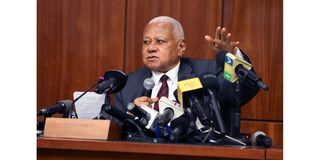
Dar es Salaam. The chairman of the commission formed to investigate the unrest that occurred during and after October elections, retired Chief Justice Othman Chande, has urged Tanzanians not to judge the commission before it begins its work, assuring the public that the team will conduct a thorough and independent inquiry.
Justice Othman, who briefed journalists today, December 1, 2025 on the commission’s terms of reference and working methodology, said the public should allow the team to “sit for its exam” before passing judgement on its performance.
His comments comes after the opposition party Chadema recently rejected the team formed by President Samia Suluhu Hassan, saying it’s not independent.
“We will leave no stone unturned,” said Justice Othman, noting that the commission will operate strictly within its terms of reference and will not entertain external directives.
He stressed that any member found to have a conflict of interest would be required to step aside to safeguard the credibility of the process.
Justice Othman said the commission has been tasked with a deep and comprehensive investigation into the disturbances, which occurred in several regions including Dar es Salaam, Arusha, Mbeya, Songwe, Mara and Geita, and which he said resulted in deaths, injuries, looting and destruction of public and private property.
He explained that the team’s responsibilities include identifying the root causes of the events, examining the intentions of those involved, assessing the extent of harm, reviewing the government’s responses and recommending measures to strengthen accountability, civic governance, human rights, political dialogue and national reconciliation. The commission also has the latitude to address any other matter it considers relevant to its mandate.
Justice Othman said the commission is empowered by law to establish its own procedures and to issue summons when necessary. He noted that the commission operates in a quasi-judicial manner, with both members and witnesses taking oaths before giving evidence.
He said information-gathering will be extensive and conducted through a wide range of methods including reviewing documents, verifying facts from multiple sides, conducting interviews—both in-person and online—using questionnaires, emails, letters, field visits, professional consultations, group discussions and telephone communication.
He added that the commission has already begun identifying key stakeholders and will continue updating the list as its work progresses.
Survivors of the incident will be prioritised during the initial stages of the inquiry, he said, in a move he described as critical to supporting healing and understanding what transpired.
While suspects will also be consulted, the commission does not have criminal jurisdiction and will not prosecute anyone, he said.
The commission has 90 days to complete its work, although Justice Othman said some sessions will be public while others will be conducted privately to protect witnesses.
Responding to concerns on legitimacy, Justice Othman said the commission is asking for cooperation rather than compelling it, though it has the legal authority to do so. He noted that it is normal for people to refuse to cooperate initially, but the commission will continue reaching out to ensure broad participation.
He acknowledged that while the inquiry focuses on events around October 29 and a day after, the team may need to examine developments from earlier periods in order to trace the underlying causes. He insisted the commission is starting its work without preconceived ideas, external pressure or existing evidence.
Justice Othman described the team as experienced and committed, saying they will find appropriate ways to involve young people who represent a key stakeholder group. He conceded that the timeframe is tight but emphasised that the team is focused on producing a high-quality, credible report.
“Do not judge us before we begin the exam. Let us sit for the exam, and then you can give us marks,” he said.
Register to begin your journey to our premium contentSubscribe for full access to premium content