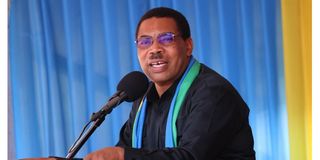
Dar es Salaam. Prime Minister, Dr Mwigulu Nchemba, has said the era of relying on foreign aid to finance development and social services is over, urging Tanzanians to embrace self-reliance in addressing national challenges.
He said the modern global economy requires countries to build strong domestic resource bases, instead of depending on external assistance.
Dr Nchemba made the remarks on Sunday, June 21, 2026, during a fundraising event for the completion of an income-generating building owned by the Anglican Church of Tanzania at the Holy Spirit Cathedral of the Central Tanganyika Diocese in Dodoma.
Speaking at the service, he said the bishop’s sermon on global change aligned with government policy on building a self-reliant economy.
“I believe the era of aid has passed. We used to have a desk managing aid funds and sector baskets, but these are no longer part of our budget. The President has consistently emphasised a budget based on domestic resources,” he said.
He said this approach should be embraced as a national mindset, noting that the Sh62.3 trillion 2026/27 budget is largely financed through domestic revenue, dividends from public institutions, and other internal sources.
He added that the government does not want essential services for vulnerable groups to keep relying on foreign aid, but instead to be supported through domestic systems.
“Previously, centres for children with special needs were often funded through foreign aid. It is time to move away from that thinking. Tanzanian children in need must be cared for by Tanzanians,” he said.
He said the government is reviewing procedures and regulations that may unintentionally encourage dependency on external assistance.
He noted that in some cases, persons with disabilities seeking assistance from public offices are issued letters to solicit funds instead of receiving direct support.
“When a person with a disability goes to a public office, they should not be sent to raise funds. They should be assisted immediately,” he said.
He urged local government authorities to identify orphanages and vulnerable groups so they can be supported through formal government systems.
Earlier, the cleric who led the service said Tanzania has sufficient resources, adding that it is unfortunate for churches to rely on letters seeking foreign assistance.
He noted that churches in Europe and the United States have also seen declining attendance and capacity, making long-term reliance on them difficult.
The Anglican Church of Tanzania Archbishop, Dr Maimbo Mndolwa, said the Church operates on Holy Scripture, tradition, and reason.