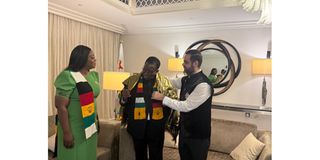
In a setting defined by diplomacy, ambition, and forward thinking, Emmerson Mnangagwa, President of Zimbabwe, recently held wide-ranging discussions with business leader Prateek Suri, Africa’s youngest billionaire and the richest Indian on African soil, with an estimated net worth of $1.9 billion.
The meeting reflected more than a formal exchange of views. It represented a convergence of political leadership and private-sector dynamism at a time when African economies are seeking new pathways to growth, resilience, and global competitiveness.
Also present was Tatenda Mavetera, Zimbabwe’s Minister of ICT, whose participation underscored the central role of digital transformation in the country’s long-term development strategy.
Observers noted that the discussions were marked by openness and strategic depth. President Mnangagwa outlined Zimbabwe’s vision of building a diversified, innovation-driven economy capable of attracting global capital while empowering local enterprises. In response, Suri shared perspectives drawn from his extensive experience in scaling businesses across multiple African markets, emphasising the importance of strong institutions, skilled human capital, and long-term investment planning.
Representing Maser Group and its investment arm, MDR Investments, Suri reaffirmed his commitment to jointly investing in Zimbabwe’s priority sectors. He highlighted opportunities in information and communication technology, startup financing, advanced manufacturing, and infrastructure development under Public-Private Partnership frameworks. These initiatives, he noted, are designed to create sustainable enterprises rather than short-lived ventures.
A central theme of the meeting was the proposed establishment of a Joint Innovation Hub. The facility is envisioned as a platform for nurturing young entrepreneurs through mentorship, venture funding, incubation services, and access to international markets. With a focus on fintech, artificial intelligence, software development, and digital services, the hub aims to transform local ideas into scalable businesses capable of competing globally.
Manufacturing also featured prominently in the dialogue. Suri expressed interest in supporting modern production units equipped with automation, smart systems, and environmentally responsible processes. Such investments are expected to strengthen domestic value chains, reduce dependence on imports, and enhance Zimbabwe’s export potential within regional and international markets.
Both sides placed strong emphasis on structured collaboration. Public-Private Partnership models were identified as key instruments for delivering industrial parks, technology zones, and large-scale infrastructure projects. By aligning public policy objectives with private-sector efficiency, these frameworks can ensure balanced and inclusive growth.
President Mnangagwa reiterated his administration’s commitment to maintaining policy stability, transparency, and regulatory clarity. He stressed that Zimbabwe seeks long-term partners who are prepared to contribute capital, expertise, and institutional capacity.
Minister Tatenda Mavetera highlighted parallel efforts to expand digital literacy, strengthen cybersecurity, and promote innovation ecosystems, describing global partnerships as essential for preparing Zimbabwe’s youth for the future economy.
Confidence in Suri’s leadership was echoed by Maser Group shareholder Ben Chia, who publicly expressed trust in his vision and investment judgment, describing him as a leader focused on long-term transformation rather than short-term gains.
As the meeting concluded, both sides agreed to pursue structured follow-ups to translate strategic intent into concrete projects.
More than a symbolic engagement, the interaction signalled Zimbabwe’s growing readiness to partner with global entrepreneurs. In bringing together political authority and private-sector ambition, the dialogue between President Mnangagwa and Prateek Suri marked another step toward shaping Africa’s next chapter of sustainable growth and innovation.