Tanzania draws a bold line to resilience as teacher education project closes
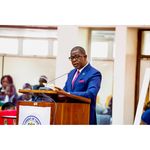
Deputy Permanent Secretary in the Ministry of Education, Science and Technology, Prof Daniel Mushi speaks at the conclusion of the Teacher Education Support Project (TESP) held on Saturday, April 11, 2026, in the Tanzania administrative capital, Dodoma. PHOTO|KATARE MBASHIRU
Dodoma. A major chapter in Tanzania’s education reform journey has closed with a powerful call to action, as government leaders and international partners shifted focus from achievement to sustainability at the end of a landmark teacher training initiative.
Speaking on behalf of the Permanent Secretary in the Ministry of Education, Science and Technology, Deputy Permanent Secretary Prof Daniel Mushi told delegates that the conclusion of the Teacher Education Support Project (TESP) was not an endpoint but a turning point for the country’s education system.
“This is not just a closing meeting; it is a moment of accountability, reflection, and transition,” he said at the New Generation Hall in Dodoma.
“We are moving from support to sustainability,” added Prof Mushi.
The project, implemented since 2017 through a partnership between the government of Tanzania and Canada via Global Affairs Canada, has significantly transformed teacher education nationwide.
At its inception, teacher training institutions faced deep challenges, including limited learning materials, weak infrastructure, and gaps in tutor capacity.
Nearly a decade later, officials say the landscape has been reshaped.
Among the standout achievements, more than 196,000 textbooks were distributed across all 35 teacher colleges, while integration into the Consortium of Tanzania University Libraries expanded access to academic resources.
The digital shift has also been striking. Over 1,400 ICT devices, including computers, projectors, and printers, were delivered, modernising classrooms and improving the quality of instruction.
“Infrastructure development has gone hand in hand with technology. New and rehabilitated libraries, laboratories, and ICT facilities have strengthened hands-on, competency-based training,” he said, adding that at Kabanga Teachers College, a clean energy model now stands as a national benchmark for sustainable education facilities.
The Deputy PS further noted that human capacity has equally improved, noting that more than 1,300 tutors have been trained in modern teaching methods, inclusive education, gender responsiveness, and ICT integration.
Meanwhile, nearly 73,000 student teachers graduated during the project period, significantly expanding the country’s education workforce.
Officials also highlighted progress in gender inclusion, with a dedicated strategy helping to create more equitable learning environments.
“These are not just achievements, they are investments in the future of our education system,” said Prof Mushi.
He challenged institutions and stakeholders to confront the critical question of sustainability, warning that without continued commitment, the gains risk fading.
“The foundation has been laid. The responsibility now rests with us,” he said.
The government outlined key priorities moving forward, including sustained financing, strong institutional leadership, proper maintenance of infrastructure and ICT systems, and continuous professional development for tutors.
Participants were urged to go beyond discussion and produce concrete, time-bound action plans.
This includes developing strategies to sustain investments, scaling successful interventions to other institutions, and strengthening coordination across ministries and partners.
The meeting also called for measurable targets over the next three to five years to ensure progress remains on track.