Dar es Salaam. On January 9, 2018, United States Congressman Brendan Boyle tabled proposals during the 115th Congress session seeking amendments to the 1971 Election Campaign Act requiring presidential candidates to undergo mental fitness examinations and publicly disclose the results before elections.
The proposal was registered as Bill HR 4742.
The proposed amendments later became widely known as the “Stable Genius Act”, a phrase derived from how President Donald Trump repeatedly described himself while insisting he possessed exceptional and unwavering intelligence.
The proposal was driven by concerns that Trump was mentally unfit to lead and that Americans should not again elect a president without understanding the state of his mental health.
Critics argued that Trump’s excessive confidence in his own intelligence reflected dangerous overconfidence, itself viewed by some as a psychological concern.
For that reason, the phrase “stable genius” gradually shifted from describing intellectual consistency to symbolising what critics considered unstable behaviour. That is why the proposed amendments to the Election Campaign Act became known as the Stable Genius Act.
The bill was reintroduced on July 12, 2019, during the 116th Congress under Bill HR 3736.
However, no further action was taken after its reintroduction. Trump later contested the presidency in both 2020 and 2024 without any requirement for mental assessment. His eventual return to power in 2024 was viewed by critics as the beginning of renewed global instability.
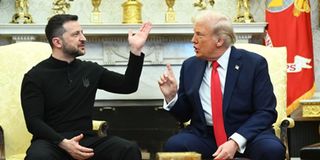
On February 28, 2025, Trump hosted Ukrainian President Volodymyr Zelenskyy at the White House in a meeting held inside the Oval Office. The talks, attended by Vice President JD Vance, attracted global attention after Trump and Vance publicly rebuked Zelenskyy instead of engaging in diplomatic discussions aimed at ending the Russia-Ukraine war.
At a time when US foreign policy traditionally sought to portray America as a defender of democracy, equality and the rule of law, Trump further damaged that image by invading Venezuela and removing former president Nicolás Maduro from power. Trump openly declared that the United States intended to benefit from Venezuela’s oil resources.
The Greenland dispute has since cooled, particularly after Trump, in cooperation with Israel, launched attacks against Iran.
Tehran responded militarily and surprised many observers with the scale of its capabilities. Trump had earlier insisted the United States needed control of Greenland for security reasons, although many analysts believe the territory’s vast mineral wealth was the real attraction.
Greenland covers roughly 2.2 million square kilometres, making it comparable in size to the Democratic Republic of the Congo or Saudi Arabia. For decades, Greenland’s economy has relied mainly on fishing and financial support from Denmark.
In recent years, however, attention has increasingly shifted to Greenland’s natural resources. The territory is believed to possess substantial reserves of rare earth minerals, uranium and iron ore. This is precisely what intensified Trump’s interest in controlling Greenland.
As debate over Greenland continues, Trump has also revived his controversial proposal to turn Canada into the 51st state of the United States. For more than two centuries, America has existed as a union of 50 states, but Trump has repeatedly suggested expanding that number by incorporating Canada.
Regarding Iran, it is increasingly evident that the invasion failed to achieve its objectives. Trump’s actions have contributed to a worsening global cost-of-living crisis after Iran retaliated by threatening to close the Strait of Hormuz, triggering sharp increases in global oil prices.
Trump’s decision to attack Iran militarily was largely influenced by his close partnership with Israeli Prime Minister Benjamin Netanyahu.
However, Trump’s constantly shifting positions have also fuelled tensions between Tel Aviv and Washington over whether the war should continue or stop.
Within a single day, Trump often issues several contradictory statements. Critics argue such behaviour has weakened the prestige of the US presidency and diminished confidence in the country itself. For years, the United States defended Taiwan’s separation from China. Yet during Trump’s visit to China from May 13 to 15, 2026, he warned Taiwan against declaring formal independence.
Trump’s remarks were widely viewed as a major setback for Taiwan’s relationship with Washington. Nevertheless, some observers urged the Taiwanese government to ignore the comments because Trump frequently reverses his own positions within short periods.
Canadian writer J Michael Cole, who lives in Taipei, Taiwan, advised the Taiwanese government not to overreact to Trump’s remarks.
“We must remember that Trump has a habit of saying many things. Sometimes he contradicts himself within 24 hours depending on what he has heard at that moment and whom he has spoken to,” said Cole, effectively urging officials to treat Trump’s statements cautiously.
At the same time, information compiled by Artificial Intelligence indicates that Trump has made more than 30,000 statements later proven false. Critics say this further reinforces arguments that many of his remarks should not be taken seriously.
On Tuesday, May 19, 2026, The New York Times published findings showing that 64 percent of Americans opposed their country entering war with Iran. At the same time, anti-Trump demonstrations known as “No Kings” reflected growing resistance to what protesters described as authoritarian tendencies within the United States.
The protests underscored mounting domestic pressure on Trump ahead of the midterm elections scheduled for November 3, 2026. Trump fears that heavy Republican losses in Congress could expose him to attempts to remove him from office.
However, one reality remains increasingly clear: Trump’s presidency has had profound consequences for US foreign policy. America’s global soft power has weakened significantly during his second term in office.
Register to begin your journey to our premium contentSubscribe for full access to premium content