Tanzania now seeks deeper strategic ties with European Union
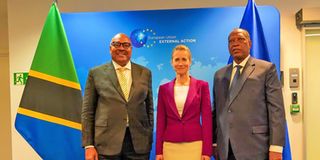
The minister for Foreign Affairs and East African Cooperation, Mahmoud Thabit Kombo (left), and the minister of State in the President’s Office, Prof Palamagamba Kabudi (right), pose for a photograph with EU Vice-President and High Representative for Foreign Affairs and Security Policy, Kaja Kallas, in Brussels. PHOTO | COURTESY OF MINISTRY FOR FOREIGN AFFAIRS AND EAST AFRICAN COOPERATION.
Dar es Salaam. Tanzania has further strengthened its strategic engagement with the European Union (EU) following a successful round of high-level consultations in Brussels, led by the minister for Foreign Affairs and East African Cooperation, Mr Mahmoud Thabit Kombo.
A statement released to the media by the ministry for Foreign Affairs and East African Cooperation yesterday indicated that Mr Kombo held official meetings with EU Vice-President and High Representative for Foreign Affairs and Security Policy Kaja Kallas, the EU Political and Security Committee (PSC), European Parliament Vice-President Younous Omarjee, and EU Commissioner for International Partnerships, Jozef Síkela.
The discussions focused on practical cooperation in trade, investment, peace, and security, as well as on creating predictable frameworks that support effective programme delivery.
Speaking on the engagements, Mr Kombo said the consultations were conducted “at the heart of Europe” and represented a deliberate investment in relationship-building across EU institutions.
“They are designed to deepen trust, broaden cooperation channels, and strengthen Tanzania’s profile as a stable, credible, and opportunity-rich partner for trade, investment, and development cooperation,” he added.
Accompanied by a ministerial delegation that included the minister of State in the President’s Office, Prof Palamagamba Kabudi, Mr Kombo emphasised the importance of rules-based trade, investment facilitation, and multi-sector collaboration.
He noted that meetings with the PSC—the EU’s principal ambassador-level forum for foreign, security, and defence policy—provided Tanzania with a platform to present its perspectives and reaffirmed the country’s standing as a reliable partner on regional peace and stability.
Parliamentary diplomacy was also prioritised during discussions with European Parliament Vice-President Younous Omarjee, supporting long-term cooperation on governance, trade, and people-to-people relations.
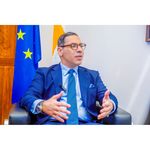
Development cooperation and investment promotion featured prominently in talks with Commissioner Jozef Síkela. Mr Kombo highlighted that Tanzania is prioritising “bankable, high-impact initiatives that generate employment, skills development, value addition, and resilient infrastructure, in line with our national transformation agenda.”
The Brussels consultations align fully with the foreign policy vision articulated by President Samia Suluhu Hassan, emphasising pragmatism, respect for national sovereignty, and consistent engagement with international partners.
“Tanzania continues to pursue win-win cooperation models that advance national development priorities while delivering value to our international partners,” he said.
Dialogue
The discussions followed the October 2025 General Election and ongoing domestic processes, including the Independent Commission of Inquiry into post-election violence.
“Sustained dialogue with the EU ensures these national processes are well understood, while safeguarding continuity in development cooperation, investment flows, and economic confidence,” Mr Kombo added.
Tanzania’s delegation in Brussels included Prof Kabudi, Ambassador Swahiba H. Mndeme, Ambassador Jestas Abuok Nyamanga, and other senior officials. Mr Kombo noted that the engagements demonstrate Tanzania is “not a passive recipient of cooperation but a proactive and confident partner, shaping its international relationships and securing practical outcomes for the benefit of our people.”