Dar es Salaam. Tanzania is seeking to deepen economic cooperation with Russia, targeting increased investment in strategic sectors including mining, infrastructure, energy and agriculture following President Samia Suluhu Hassan’s recent landmark visit to the Russian Federation.
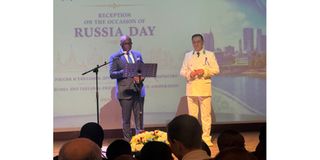
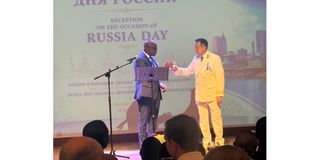
The call was made during celebrations marking Russia Day at the Russian Cultural Centre in Dar es Salaam over the weekend. The event, hosted by Russian Ambassador to Tanzania, Andrey Avetisyan, was dedicated to Crimea and brought together government officials, diplomats, business leaders and members of the Russian community in Tanzania.
Speaking at the event, Minister for Minerals Anthony Mavunde said relations between the two countries had entered a new phase driven by stronger economic diplomacy and growing trade ties.
Mr Mavunde, who represented the Tanzanian government at the event, said President Samia Suluhu Hassan’s state visit to Moscow and St. Petersburg earlier this month had opened a new chapter in bilateral relations.
“This was a truly historic moment and the first visit by a Tanzanian Head of State to Russia in nearly six decades,” he said. “The discussions between President Samia Suluhu Hassan and President Vladimir Putin have injected fresh momentum into our partnership and laid a strategic roadmap for future cooperation.”
The minister noted that Tanzania and Russia are preparing to mark 65 years of diplomatic relations, recalling that Russia was among the first countries to recognise Tanzania’s independence and establish diplomatic ties in December 1961.
According to Mr Mavunde, bilateral cooperation has expanded beyond historical and political ties to include trade, investment, education, tourism, energy and mining.
He said annual trade between the two countries has been growing by an estimated 20 to 25 percent, with dozens of Russian companies sourcing products from Tanzania while Tanzanian firms continue to import goods from Russia.
To accelerate this growth, Tanzania is inviting more Russian state-owned corporations and private investors to explore opportunities in the country.
“We welcome targeted partnerships in strategic infrastructure, mineral value addition, green energy and large-scale modernised agriculture,” Mr Mavunde said.
The minister also highlighted growing collaboration in education, noting that Russia has expanded scholarship opportunities for Tanzanian students to 150 annually, alongside additional slots offered by Russian universities.
He said language and cultural exchanges would play an important role in strengthening future cooperation, particularly among young people.
Another major outcome of President Samia’s visit, according to Mr Mavunde, is the planned launch of direct Air Tanzania flights linking Tanzania and Russia from July.
He described the new route as a significant milestone expected to boost tourism, trade and investment by reducing travel barriers between the two countries.
In the mining sector, Mr Mavunde reaffirmed the government’s commitment to the development of the Mkuju River uranium project being implemented by Mantra Tanzania Limited, a subsidiary of Rosatom.
He said the project, which is expected to be completed by 2028, represents one of Tanzania’s highest-priority strategic investments and will support the country’s entry into the nuclear energy value chain.
“The project demonstrates our shared commitment to using advanced technologies to support sustainable industrial and economic development,” he said.
Mr Mavunde added that the government remained committed to supporting Rosatom’s long-term engagement in Tanzania and facilitating the successful implementation of the project.
He further reiterated Tanzania’s commitment to maintaining strong bilateral relations with Russia based on mutual respect, sovereign equality and shared development interests.
“As President Samia stated during her visit, Tanzania values Russia’s long-standing friendship and contribution to Africa’s development,” Mr Mavunde said. “The success of the recent visit demonstrates what can be achieved when nations build bridges based on mutual respect and common interests.”