Tanzania targets over 30 million tonnes annually at Dar Port as capacity expands

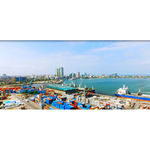
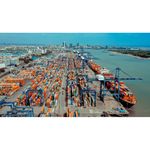
A large vessel with a capacity of 6,000 tonnes of grain offloads wheat at the Port of Dar es Salaam on Tuesday, January 20, 2026. PHOTO | COURTESY

Dar es Salaam. Tanzania is targeting cargo throughput at Dar es Salaam Port of more than 30 million tonnes a year as sweeping infrastructure upgrades and operational reforms unlock new capacity at the country’s main maritime gateway.

Government Chief Spokesperson Gerson Msigwa said on Tuesday, January 20, 2026, that the target marks a major increase from the port’s historical handling capacity and reflects the scale of investments now being rolled out to reposition Dar es Salaam as a leading logistics hub for East and Central Africa.

Speaking after touring the port, Mr Msigwa said Dar es Salaam port had already recorded strong gains, with cargo throughput reaching 27.7 million tonnes in the 2024/25 fiscal year, up from 23.69 million tonnes a year earlier.

From July to December 2025 the port handled 16.7 million tonnes, a 30 percent rise compared with the same period in 2024.

“These numbers show that we are already moving toward the 30 million tonne mark. What we are seeing today is the result of strategic investments, better equipment, and improved systems,” said Mr Msigwa.

Customs revenue linked to port trade reached Sh12.33 trillion in 2024/25, up 17 percent from the previous year, underscoring the fiscal stakes of the port modernisation drive.

The Tanzania Ports Authority says operating costs at Dar es Salaam Port have fallen by about 57 percent following the involvement of two private operators, lifting its profit margin from roughly 66 percent to 78 percent.

Dar es Salaam Port’s regional footprint is also expanding. In 2024/25 it handled nearly six million tonnes of cargo for the Democratic Republic of Congo, 3.5 million tonnes for Zambia, 1.7 million tonnes for Rwanda, and significant volumes for Burundi, Malawi, Uganda and Zimbabwe, reinforcing Tanzania’s role as a logistics lifeline for central and southern Africa.

Beyond Dar es Salaam, the government is pursuing a nationwide port modernisation programme to increase capacity, decongest the main harbour and diversify cargo handling across multiple gateways.

At the heart of Dar es Salaam’s next growth phase are projects to deepen berths, add oil storage infrastructure and build new terminals capable of handling larger vessels.

Construction is under way on a new oil jetty and 15 storage tanks with a combined capacity of 378,000 litres; the project is about 35 percent complete.

Once operational, it is expected to reduce discharge bottlenecks and improve the port’s petroleum-handling capacity.

A separate project to rebuild Malindi Wharf into a 500-metre berth is also in progress.

When completed, it will allow two vessels of up to 50,000 deadweight tonnes to be served simultaneously, easing congestion and boosting handling capacity.

Plans are advancing to rehabilitate berths 8 to 11 and construct new berths 12 to 15, while a new rail link inside the port, integrating the standard gauge railway, metre-gauge railway and the Tanzania and Zambia Railway Authority (Tazata) line, is expected to raise annual container throughput by up to 480,000 TEUs and increase the share of cargo moved by rail from about two percent to 12 percent.

“These projects will enable Dar es Salaam to handle post-Panamax vessels of up to 8,000 TEUs and lengths of 305 metres, compared with the current generation of ships that carry about 2,000 to 2,500 TEUs,” said Mr Msigwa.

The government’s strategy also includes scaling up secondary ports to relieve pressure on Dar es Salaam and unlock regional economic potential.

At Mtwara, a new 300-metre berth, hardstand yards and warehouse upgrades have lifted throughput from about 592,000 tonnes in 2021/22 to 2.58 million tonnes in 2024/25.

A specialised port at Kisarawe’s Mgao area is being built to handle coal and cement, while construction and expansion projects are at advanced stages in Bukoba, Kemondo, Mwanza North, Kigoma, Mbamba Bay and Tanga.

The second phase of Tanga Port’s upgrade has doubled its capacity from 500,000 tonnes to 1.29 million tonnes a year.

Taken together, these investments are intended to sharpen Tanzania’s competitive edge against rival Indian Ocean ports such as Mombasa, Beira, Nacala, Maputo and Durban.