The complex journey of children with special needs in pursuit of education
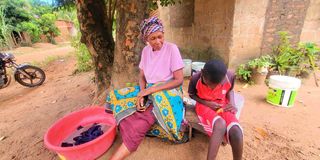
Jafari Mwinyi, 11, with his grandmother, Janeth Kajiri. Mwinyi is among children with disabilities who have been unable to attend school due to a lack of assistive devices. PHOTOS | ELIZABETH EDWARD
Dar es Salaam. Every morning, millions of children wake up, put on their uniforms and head to school without thinking about the obstacles that might stand between them and a classroom.
For Ashinilat and Siwajibu, however, the journey to education is a daily struggle marked by transport challenges, inaccessible environments and a lack of essential support equipment needed to help them learn and live independently.
The two pupils at Nianjema Primary School in Bagamoyo District, Coast Region, live with physical disabilities that have left them unable to walk or move around without assistance.
For them, going to school is not simply about attending lessons; it is a battle fought every day.
Inside the classroom, they spend their school day seated on special chairs and depend on others for many routine activities.
Their class teacher, Mary Gervas, witnesses their struggles daily while trying to ensure they are not denied their right to education.
According to Gervas, Ashinilat’s school day begins with a motorcycle taxi journey.
“When he arrives at school, the rider carries him into the classroom. Without that assistance, it would be difficult for him to attend lessons,” she says.
For Siwajibu, the challenge is even greater.
He depends on his father’s bicycle to reach school, but the bicycle also serves as the family’s main means of transport for other daily activities.
Whenever it is needed elsewhere, Siwajibu remains at home and misses lessons.
There are times when he has even missed examinations despite living only one kilometre from school.
Poverty and a lack of mobility support equipment have turned what appears to be a short distance into a major obstacle. The difficulties do not end once the children arrive at school. Even using the toilet becomes another challenge requiring support from others.
Without mobility devices, Ashinilat and Siwajibu are carried on the backs of female classmates whenever they need to go to and from the toilet.
The situation denies them independence while also placing additional responsibility on pupils who volunteer to help them.
“If they had support equipment, they would be able to do more for themselves and reduce their dependence on others,” says Gervas.
Despite the challenges, Gervas has refused to give up.
She often remains at school until 4pm or 4:30pm waiting for relatives to collect the pupils after classes end.
Her biggest concern is now Siwajibu’s academic progress, which she says has started being affected by transport difficulties.
Beyond Ashinilat and Siwajibu, there is also 11-year-old Jafari Mwinyi, whose dream of going to school remains unfulfilled.
Despite his enthusiasm for learning, Mwinyi has never stepped into a classroom because of intellectual and physical disabilities.
Although he was assessed and registered at Kapolo Primary School in Ifakara, Morogoro Region, he has never attended school because of his condition, lack of support equipment and the long distance to school.
Mwinyi, who lives with his grandmother Janeth Kajiri in Kapolo Village, often watches other children pass by his home wearing school uniforms and carrying bags as they head to class.
Speaking to Mwananchi, Kajiri says her grandson often asks when he too will be able to go to school like other children.
“As you can see, he cannot go to school by himself and the school where he was registered is four kilometres away. Carrying him to and from school every day is simply impossible,” she says.
For Mwinyi, a right many children take for granted has become a dream waiting to be realised.
That dream, his family says, could begin with something as simple as access to a mobility device. Inclusive education still facing challenges
The stories of Ashinilat, Siwajibu and Mwinyi reflect the broader challenges facing implementation of inclusive education in Tanzania.
Although the government has continued efforts to promote inclusive education, many primary schools still face obstacles that prevent children with special needs from learning in a dignified and equal environment.
Tanzania formally introduced inclusive education in 1998 through a pilot project implemented by the Ministry of Education in collaboration with Unesco in selected schools in Dar es Salaam.
The programme aimed to ensure children with disabilities studied alongside their peers in mainstream classrooms.
The initiative was later strengthened through the National Policy on Persons with Disabilities of 2004.
However, implementation has continued to face setbacks due to shortages of essential resources, including assistive devices, specialised teachers and supportive learning environments.
The shortage extends beyond mainstream classrooms and affects specialised units designed to support children with different forms of disability.
Suzan Nkya, head of the special needs education unit at Nianjema Primary School, says one of the biggest challenges is a shortage of therapeutic equipment, particularly for pupils with physical disabilities who require physiotherapy.
“Although some equipment exists for children with intellectual disabilities, therapeutic exercise equipment remains a major challenge,” she says.
She explains that the shortage directly affects implementation of inclusive education because some pupils are forced to sit on floors for long periods due to a lack of specialised chairs.
“The number of chairs is limited and teachers cannot support children throughout the school day. We often use mats because ordinary chairs are not safe and pupils can fall or be pushed by others,” she says.
According to Nkya, the challenges have discouraged some parents, with some withdrawing their children from school because they do not see immediate improvements.
“Some parents become discouraged and stop bringing their children to school because they do not see quick changes. The reality is that these children need time to learn and develop,” she says.
The situation is also evident in Kilombero District in Morogoro Region, where Mwananchi found that children with special needs continue to face numerous challenges that leave some outside the education system.
Ifakara Education Officer Ester Kilima acknowledges that despite efforts to strengthen inclusive education, significant obstacles remain.
She cites shortages of teachers, support equipment and limited public awareness about the importance of education for children with special needs as key factors affecting implementation.
Tomorrow: Government measures aimed at strengthening implementation of the inclusive education strategy.
Register to begin your journey to our premium contentSubscribe for full access to premium content