Tanzania has lost one of its seasoned politicians who carried decades of experience, a legacy that will continue to be discussed for many years to come.
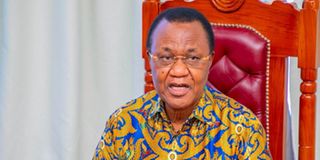
Dar es Salaam. He began as an ordinary teacher before rising to become one of the ministers who captured public attention through his distinctive leadership style and unwavering convictions.
He was a son of Mapogoro village before becoming a prominent figure in Dodoma.
That was William Vangimembe Lukuvi, a name that gradually evolved into a symbol of experience in Tanzania’s politics and public leadership.
However, no one speaks with God, and at exactly 7 am on Wednesday, March 25, 2026, his earthly journey came to an end.
His heart stopped at Benjamin Mkapa Hospital, leaving a void that even his critics may concede will not be easy to fill.
A son of the soil of Mapogoro
Mr Lukuvi was born on August 15, 1955, in Mapogoro Village, Iringa Rural District, and it may be said that great dreams are often born quietly.
There was no sign that the child would one day stand before the nation’s top leaders and hold some of the most sensitive positions in government.
He received his primary education at Kitanewa Primary School before joining Tabora Teachers’ Training College in 1975.
It was there that he began his teaching career, a profession he served with dedication for five years from 1975 to 1980 under the Ministry of Education.
However, within him there was an inner drive that pulled him beyond the classroom.
He longed to take part in broader decision-making that touched society as a whole.
From Moscow to Washington
The 1980s found Lukuvi far from home, living in Moscow, then a centre of intense political debate.
While at Komsomol College between 1982 and 1983, he obtained a Diploma in Political Science.
There, he not only learned theories from books but also broadened his perspective through discussions with students from different continents.
That experience laid the foundation for the leadership he would later demonstrate.
Many years later, already an experienced leader, he returned to academic studies and obtained a Bachelor’s degree in International Relations and Diplomacy from Washington International University, followed by a Master’s degree in Political Science from the Open University of Tanzania (OUT).
His Master’s dissertation, analysing the challenges of democracy and political stability in the country, showed how Mr Lukuvi viewed politics not only as a participant but also as a researcher.
A long-serving Member of Parliament
In the 1995 General Election that marked the consolidation of the multiparty political system, Mr Lukuvi entered the political arena by contesting the Isimani parliamentary seat under the ruling CCM. Voters granted him their mandate.
From that moment, he never looked back. Over 30 years, he continued to win elections six consecutive times, a record placing him among the longest-serving Members of Parliament in Tanzania’s history.
His ability to remain steadfast during turbulent political periods earned him respect even among analysts who regarded him as a reservoir of experience not easily found.
In 2015, the fifth-phase President, the late Dr John Magufuli, entrusted him with leading the Ministry of Lands, Housing and Human Settlements Development, a ministry facing major challenges linked to persistent land disputes.
During his tenure, he oversaw the issuance of over two million land title deeds, enabling citizens to formally own their property and use it as economic collateral.
But perhaps the event that best demonstrated his principles occurred in 2017. His own house, located within a road reserve area, was scheduled for demolition.
Instead of using his authority to block the exercise, he allowed the law to take its course.
The Tanzania National Roads Agency (Tanroads) demolished the house, and the minister remained an enduring example of obedience to the rule of law.
A leader of the people
In 2018, he conducted visits to Karagwe and Kyerwa districts in Kagera Region, meeting hundreds of citizens each day and listening to their grievances directly.
He cultivated an image of a leader who listened, remained close to the people, and took action.
However, in 2022, President Samia Suluhu Hassan relieved him of his duties at the Ministry of Lands with honour, citing the importance of his experience in mentoring and supporting the next generation of leaders.
Later, he was appointed Special Adviser to the President before returning to government in 2024 as Minister of State in the Prime Minister’s Office (Policy, Parliament, Coordination and Persons with Disabilities), a position he continued to hold even after the 2025 General Election.
The legacy that remains
Like many political leaders, he was not without criticism. Some of his policies faced opposition, and there was public debate surrounding certain personal and political matters.
However, his contribution remains firmly embedded in the country’s leadership history.
He is remembered as a teacher who became a minister, a long-serving Member of Parliament, and a leader who dared to place the law above personal interest even when it affected him directly.
His earthly journey has ended quietly, just as it began. Yet news of his death has spread rapidly, stirring emotions among many people from Isimani to Kagera and from Parliament to the streets.
Tanzania has lost one of its seasoned politicians who carried decades of experience, a legacy that will continue to be discussed for many years to come.