Dar es Salaam. As In Vitro Fertilisation (IVF) continues to offer hope to couples struggling with infertility, debate has intensified over treatment costs at Muhimbili National Hospital (MNH), where a single cycle ranges between Sh14 million and Sh18 million.
To many Tanzanians, the price appears prohibitively high. However, Head of the IVF unit at MNH and consultant obstetrician-gynaecologist, Dr Matilda Ngarina, says the cost reflects a highly complex medical process dependent on advanced technology, tightly controlled laboratory conditions, imported medicines and round-the-clock supervision by trained professionals.
According to MNH, patients who successfully preserve embryos but do not conceive on the first attempt pay Sh1 million for a repeat embryo transfer. The procedure can be repeated up to four times within a year using stored embryos, at the same cost per attempt.
Dr Ngarina said in an interview that the public often assumes IVF costs are mainly driven by injections and medicines.
She said the reality is far more complex, involving specialised laboratory infrastructure and continuous monitoring systems that operate 24 hours a day.
“People think it is only about injections and medicines, but there are many other things involved,” she said.
“There is liquid nitrogen, specialised gases, backup electricity, staff monitoring the laboratory throughout the night, equipment maintenance, testing and calibration of embryo incubators under controlled temperatures. All these contribute to the final cost,” she said.
Laboratory that never sleeps
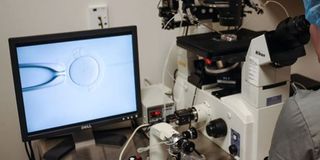
Dr Ngarina described the IVF laboratory as a “life factory,” where even minor technical failures can compromise treatment outcomes.
She said embryo incubators and related equipment must maintain precise temperature, air and humidity conditions at all times.
“Embryo incubators require regular maintenance, calibration and accuracy testing. Sometimes the equipment must even be sent abroad for servicing. All this comes at a cost,” she said, adding that uninterrupted power supply is critical.
“You cannot afford even a second of power interruption. There is a backup generator and dedicated staff to ensure stability at all times. A slight fluctuation can affect the entire system,” she said.
Other costs include specialised gases, liquid nitrogen for preservation, consumables, cleaning services and overnight staffing.
“Even tissue paper, water, cleaning services, and staff working overnight to ensure the system functions properly are paid for. This is a 24-hour operation,” she said.
Dr Ngarina said the Sh14 million to Sh18 million covers the full treatment cycle up to pregnancy, excluding delivery and post-pregnancy care.
Imported medicines
She said the cost of IVF is also driven by expensive imported medicines, many of which have short shelf lives.
“You cannot buy and store large quantities because some medicines expire within two or three months,” she said.
She noted that the hospital initially faced procurement challenges within the government supply system.
“At first we thought we could work directly with manufacturers, but later realised they operate through authorised distributors,” she said.
MNH is now engaging suppliers in long-term discussions to improve availability and streamline procurement.
Step-by-step procedure
Dr Ngarina said IVF begins with hormone injections administered for about 14 days to stimulate egg production.
Doctors then retrieve the eggs through a specialised procedure before fertilising them in the laboratory using sperm from the male partner to form embryos.
The embryos are later transferred into the uterus.
“There is a period of hormone injections that can last up to 14 days. After that, we retrieve the eggs, create embryos and transfer them into the uterus,” she said.
However, she stressed that IVF does not guarantee pregnancy.
“Globally, the success rate is about 40 percent. Sometimes everything is done correctly, yet pregnancy still does not occur,” she said.
She added that outcomes can be unpredictable even when embryos appear viable.
“You may transfer two strong embryos and still fail, while another weaker embryo succeeds. There are things we still do not fully understand,” she said.
Multidisciplinary care and emotional strain
Dr Ngarina said IVF treatment involves a multidisciplinary team, including laboratory biologists, doctors, surgeons and counsellors.
“Patients are not treated by a single doctor. It is a team involving laboratory specialists, clinicians, laparoscopic surgeons and counsellors providing psychological support,” she said.
She added that the 14-day waiting period after embryo transfer is often emotionally difficult for couples.
“This is extremely stressful. Some patients test themselves at home before results, while others experience early menstruation and seek urgent guidance,” she said.
Low natural success rates and uncertainty
Dr Ngarina said even natural conception has relatively low monthly success rates.
“Out of 10 healthy couples, only two or three may conceive naturally each month,” she said.
She said IVF outcomes depend on multiple biological factors, including egg quality, sperm quality and uterine conditions.
“Sometimes everything is done correctly, but the body still rejects the pregnancy. There are things we still do not fully understand,” she said.
Surrogacy and fertility preservation
Dr Ngarina said surrogacy is not practised in Tanzania due to the absence of specific legislation governing the process.
She added that egg freezing has not yet been formally introduced at MNH due to technological and financial constraints, although sperm and embryo preservation services are already available for selected patients.
Register to begin your journey to our premium contentSubscribe for full access to premium content