Want to criticise a colleague for their ‘bad’ English? OK, but do it in English!
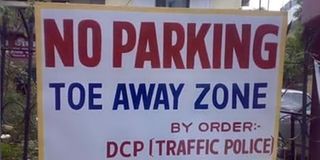
TOE AWAY Zone? No way, Sir! We’re certain the artist who handled this notice was assigned to paint “TOW-AWAY” Zone, referring to a place where motorists are not allowed to park their vehicles, lest they are towed away! Trust signwriters! PHOTO | COURTESY
It happened at a recent press conference held in Dar es Salaam, and addressed by Young African SC head coach Manqoba Mngqithi.
The South African tactician doesn’t speak Kiswahili yet. Now a journo from a city-based media outlet—who had pressing questions regarding Burkinabe attacking midfielder Aziz Ki, who rejoined the Jangwani side this season after a short stint with Morocco’s Wydad Casablanca—had to use English.
The clip went viral, not on account of the good, answers from Mngqithi, but rather, due to our colleague’s peculiar brand of English. His challenged mastery of the alien language elicited immense criticism, nay, mockery.
But what some of us failed to notice is: Coach Mngqithi understood his interviewer well, going by his body language and the educative responses he delivered.
It meant, he comprehended what his interviewer wanted to know. So, one needs to ask: what’s all the fuss about?
Language, linguists will tell you, is essentially about communication between humans and anything beyond that is just academic!
I know you are likely to ask: Abdi, if you believe that communicating and being understood by your audience is what really matters, why do you pen this column? A column that seem to seek perfection from your media colleagues?
The answer is that we of the Fourth Estate have audiences that expect that we demonstrate finesse, beauty, sophistication, and we have a duty not to disappoint them. We need to be exemplary in language use, but that is not a matter of life and death!
An amusing thing that came from virtually all of those who fried our hapless colleague is this: they did it in Kiswahili! You condemn someone’s “bad” English in Kiswahili, most likely because your own mastery of King Charles III’s mother tongue is dubitable as well. But, we wouldn’t kill you for that, would we?
Having thus lectured (bah!) let us proceed with sharing gems we picked up over the past week. Here we go...
The Friday, August 21 edition of Bongo’s huge and colourful broadsheet has a Page 3 story entitled, ‘Jobs, local business up with Mtwara Port boom.’ For an intro, the Mtwara-based scribbler writes: “Investment in Mtwara Port is transforming trade and transport ACTIVITIES creating new economic opportunities for RESIDENTS, drivers, traders and service providers as cargo volumes RISES.”
The sentence is laden with unnecessarily excessive wording. Passenger words, we call them. Why not just say “transport” instead of “transport activities?”
Why is the scribbler mentioning “residents” like it was a category that cannot do driving, engage in trade and provide services? And, we say, “...service providers as cargo volumes RISE (not rises).
Reporting further on the virtues of the Mtwara Port, the scribbler writes: “It now has FOUR berths with ONE berth measuring 300 metres...”
Here we get the idea that of the four berths, there is just one that measures 300 metres. However, it could be that he meant to inform readers the port has FOUR berths, with each of them measuring 300 metres...” This is what we call ambiguity, and it is unacceptable!
Finally, there is an opinion piece on Page 4 of Bongo’s senior-most Sunday publication of August 23, whose headline reads, ‘JNHPP: Powering Tanzania’s economic future.’
The scribbler pens in paras 1 and 2: “The official commissioning of the 2,115 megawatt Julius Nyerere Hydropower Project marks a defining moment in Tanzania’s economic transformation.
“MORE THAN a power-generating facility, the project represents a strategic investment in the infrastructure needed to drive industrialisation...”
“More than” a power generating facility...? We note a diction issue here! Our rewrite: “BESIDES BEING ...” or “APART FROM BEING” a power generating facility...”