Can the Samia-Ruto $1 billion target finally break the structural wall?
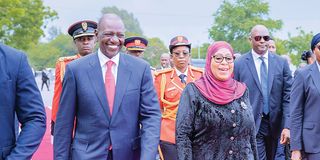
President Samia Suluhu Hassan with Kenyan President William Ruto when he arrived at State House in Dar es Salaam at the start of his two-day state visit to Tanzania on May 4, 2026. PHOTO | FILE
By Edditrice Marco
The recent state visit to Dar es Salaam on May 4-5, 2026 by Kenyan President William Ruto has rightfully been hailed as a “diplomatic reset.”
The images of Presidents Ruto and Samia Suluhu Hassan sharing a common vision for the East African Community (EAC) have fuelled much-needed regional optimism.
Yet, beneath the cordial rhetoric lies a cold economic reality: to move from “brotherly ties” to our ambitious $1 billion annual trade target, we must dismantle a long-standing structural wall.
For years, our trade relationship has been uneven, with Tanzania primarily viewed as a source of raw commodities and Kenya as the provider of manufactured goods.
This structural imbalance is a primary reason bilateral trade dipped by nearly 10 percent in 2025.
While removing non-tariff barriers (NTBs) by the 30 June 2026 deadline is a critical political milestone, it is only half the battle. Administrative changes alone cannot resolve the deeper financial friction isolating our two markets.
To hit that $1 billion target by year-end, we must move beyond the zero-sum game of retaliatory trade bans. Tanzania is no longer just a “granary” for the region; we are an emerging industrial hub.
For a sustainable partnership, the regional market must open fully to Tanzanian value-added products. Yet, removing administrative barriers is only half the battle; we must also address the financial friction that keeps our markets siloed.
Banking as the trade stabiliser
This is where our regional banking sector must step in to dismantle the wall. From a strategic banking viewpoint, I believe our role is to act as the heavy lifter by providing the financial certainty that diplomacy cannot deliver on its own.
When a Tanzanian manufacturer exports to Nairobi, they routinely face currency volatility and payment delays that eat into slim profit margins.
Banks must bridge this gap. By offering sophisticated trade finance tools, such as local-currency settlement systems and cross-border guarantees, we can ensure a businessman in Dar es Salaam is paid as reliably as if he were selling across the street.
Financing the value chain
Furthermore, to shift Tanzania from a commodity exporter to a true industrial partner, we need targeted capital. Commercial banks must move beyond traditional lending structures to finance entire production value chains; from the farm gate to the processing plant.
By providing structured trade finance to our SMEs and manufacturers, we empower them to meet the international quality standards required to scale across borders.
The eight MoUs signed this month are a vital foundation, but true economic integration requires more than diplomatic sentiment.
It requires a robust financial ecosystem that treats the EAC as a single, liquid market.
If we align our banking solutions with our political ambitions, we won’t just hit a $1 billion target; we will build an integrated industrial engine capable of competing on the global stage.
Edditrice Marco is Senior Regional Manager at Stanbic Bank Tanzania. The views expressed in this article belong solely to the author and do not reflect any position of her employer