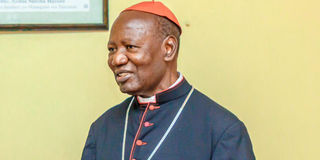
Dar es Salaam. On Thursday night, February 19, 2026, Tanzania lost an irreplaceable treasure: a voice of wisdom grounded in deep faith, scholarly rigour, and decades of devoted service to both God’s people and the United Republic of Tanzania.
Archbishop Emeritus of the Catholic Archdiocese of Dar es Salaam, Cardinal Polycarp Pengo, died aged 82.
He passed away at the Jakaya Kikwete Cardiac Institute (JKCI) in Dar es Salaam, hours after returning from India, where he had been receiving treatment since December 2025.
His death has sparked a wave of grief across society. Catholics, Muslims, Protestants, secular citizens, and the governments of Tanzania and the Revolutionary Government of Zanzibar have united in mourning a man who spoke truth with rare gentleness.
Yet beyond sorrow lies a pressing question: what has the nation truly learned from his life, and what should a new generation of religious leaders emulate from his enduring legacy?
A son of Sumbawanga who captivated Africa
The most remarkable aspect of Cardinal Pengo’s life was his journey of steady integrity.
Born on August 5, 1944, in Mwazye Village, Sumbawanga District, Rukwa Region— then a remote area with little political or economic prominence, his rise was shaped by merit and discipline.
He attended Kaengesa Minor Seminary (1959–1964) before proceeding to Kipalapala for philosophy and theology studies (1965–1971).
He was ordained a priest on June 20, 1971, by Bishop Charles Msakila in the Diocese of Sumbawanga.
After ordination, he followed a path few anticipated. Selected to study Moral Theology at the Pontifical Lateran University, he embarked on a demanding course requiring intellectual rigour, academic discipline, and patience.
After earning his doctorate in 1977, he returned to teach at Kipalapala Major Seminary.
He later became the founding rector of Segerea Senior Seminary in Dar es Salaam, establishing the institution from the ground up.
This distinction matters: Cardinal Pengo did not merely inherit authority; he built institutions and remained grounded in service.
In 1983, Pope John Paul II appointed him Bishop of Nachingwea, and in 1985, he became Bishop of Tunduru-Masasi.
By 1990, he was named Coadjutor Archbishop of Dar es Salaam, eventually succeeding Cardinal Laurean Rugambwa, the first African cardinal, in 1992.
In February 1998, Pope John Paul II elevated him to the rank of cardinal, making him only the second Tanzanian to hold this distinction.
These milestones were not mere statistics; they marked a man who served faithfully, step by step, without seeking applause.
A calm voice in a changing nation
His tenure as Archbishop (1992–2019) coincided with seismic change, including the advent of multi-party politics and mounting socio-economic pressures.
In such a volatile climate, many religious leaders opted for silence to preserve favour or employed inflammatory rhetoric that risked division.
Cardinal Pengo charted a third path. He spoke truth with restraint, criticised respectfully, and opposed wrongdoing without inciting hatred.
On corruption, he was unequivocal, describing the theft of public resources not only as a legal offence but as a grave moral sin, an argument grounded in his training in Moral Theology.
At the height of the HIV/Aids epidemic, he took a position controversial to some yet consistent with Catholic teaching: that solutions lay in personal responsibility and moral discipline, rather than reliance solely on condom distribution.
Whether one agreed or not, his stance was rooted in conviction and scholarship. He spoke truth to power without raising his voice.
A Tanzanian of global stature
Cardinal Pengo’s influence extended well beyond Tanzania. Between 2007 and 2009, he served as President of the Symposium of Episcopal Conferences of Africa and Madagascar (Secam).
He was also a member of several senior Vatican bodies, including the Congregation for the Doctrine of the Faith and the Pontifical Council for Interreligious Dialogue.
He participated in two papal conclaves: the 2005 election of Pope Benedict XVI and the 2013 election of Pope Francis, placing Tanzania in a rare position of influence within the closed chamber where Church history is shaped, a fact often overlooked at home.
He was a firm defender of African cultural dignity, opposing what he termed “ideological colonisation”, including instances where international assistance came with conditions undermining African moral and cultural values.
What has the nation learned?
Regrettably, perhaps too little. Cardinal Pengo embodied a rare blend: a religious leader who was also a serious scholar, uniting faith and reason, speaking firmly without arrogance.
Today, Tanzania often gravitates towards loud platforms where miracles are marketed, and religion risks becoming a vehicle for financial or political gain.
His voice sometimes seemed hard to hear, not due to silence, but because wisdom demands attentive listeners.
He insisted that spiritual and social truths are inseparable; the Church cannot remain passive while corruption thrives or families fracture.
Lessons for a new generation
Tanzania hosts many religious leaders across faith traditions. Yet how many combine deep learning, moral integrity, and courage to dissent without bitterness?
First, religion without education is perilous. Cardinal Pengo underwent more than a decade of rigorous philosophical and theological formation.
Today, some ascend the pulpit armed with passion but lacking scholarly grounding to interpret scripture responsibly, resulting in emotional and occasionally misleading messaging.
Second, he demonstrated that true courage is measured. One may criticise the President or the government without undermining national institutions.
His critiques flowed from faith and knowledge, not anger or self-promotion.
Third, he exemplified service over materialism. His legacy endures among the children of the Dar es Salaam Archdiocese, proudly referring to themselves as “Cardinal Pengo’s children”.
This is no empty phrase; it reflects a shepherd whose presence was tangible and whose ministry was authentic.
Remaining challenges
In honouring him, Tanzania must confront the issues he highlighted. A champion of interreligious dialogue, he consistently cautioned against inflammatory rhetoric.
The nation must safeguard religious diversity as a strength, not allow it to become a fault line.
In his final days, a frail Cardinal Pengo returned from India, perhaps wishing to draw his last breath in the country he had served for decades. That journey spoke quietly of patriotism.
Tanzanians must now decide what to do with his example. Was his voice merely heard, or truly understood?
He was not without controversy; he was human and held positions that drew disagreement. Yet he harmonised faith and reason, courage and gentleness.
A nation confronting moral and social trials needs such voices. The question is whether citizens, clergy, and leaders will rise to the weight of his example, or simply offer tributes while persisting in practices he opposed.
May the soul of Cardinal Polycarp Pengo rest in eternal peace. Amen.
Register to begin your journey to our premium contentSubscribe for full access to premium content