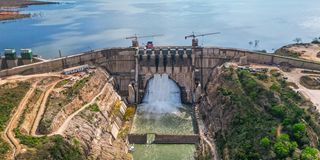
Her Excellency, President Samia Suluhu Hassan, officially inaugurated the 2,115-megawatt Julius Nyerere Hydropower Plant on August 22, 2026, in the Rufiji District of the Coast Region.
This was a moment for all Tanzanians to jubilate, given the fact that this is a project, which has been mooted by various governments in the past, but which has always been seen as too daunting a task to undertake.
We now have the dam, “habemus dam”, it is time to rejoice and enjoy the fruits of this gargantuan piece of a power generation project. As a person interested in financing development infrastructure, I turned to finding out what the capital structure for this project was.
I expected to see terms like equity, syndication, concessional and commercial loans, hybrids, grants and so on, and how these were put together to finance the project. Nothing of the sort.
The Julius Nyerere Hydropower Station was fully funded and owned by the Government of Tanzania through public domestic financing, costing an estimated total of $2.9 billion. The financing therefore, was entirely from internal revenue sources, mainly taxes; from the national budget’s development expenditure.
This is certainly a good case study for students and practitioners of financing infrastructure, that big projects can be accomplished using internal revenue. It is a case demonstrating that where there is determination, there is a way; where there is will, there is a dam.
The contractors for this dam were a joint venture of Egyptian firms, The Arab Contractors (Osman Ahmed Osman & Co.) and Elsewedy Electric. The contract type was what is known as Engineering, Procurement, and Construction (EPC) contract. It was signed in December 2018. Hopefully, our engineers garnered a lot of experience therefrom.
The owner and operator for this project are the Tanzania Electric Supply Company (TANESCO), the state-owned utility company, which is also the off taker.
Between rejoicing, however, we must remember that the dam needs looking after. Let us remember the Swahili adage of the old translated to mean that, once a child is born, one hard task stands accomplished; but there is a harder task of upbringing the newly-born.
Maintaining infrastructure is a big problem in African countries; a problem which drags back our development.
We see this in road infrastructure; and in buildings, in water and energy supply networks. Dams have their own particular problems, a good number of which are in the realm of engineering and it is thus, imperative to have a maintenance schedule.
There are structural and geotechnical issues to reckon with. Some are related to dam foundation stability: Massive weight and high-water pressure can cause sliding or seepage at the dam base or abutments, requiring complex grouting and drainage. Structural failure of dams is rare but if it does it can cause catastrophic flooding downstream, and engineers must always be on the look-out.
Some problems are related to slope stability, For example, surrounding reservoir hillsides can experience landslides when water levels fluctuate, risking sudden waves or blockage.
A major problem is what is known as sedimentation: Silt and sand carried by rivers erode turbine runners and fill up reservoir storage capacity, lowering plant efficiency and lifespan.
This was experienced in the past with regard to the Kidatu Hydroelectric power plant, when the reservoir capacity became smaller as a result of sedimentation which moreover contributed to higher levels of water evaporation, leading to serious inefficiency of the plant.
Dredging is possible, but it is very expensive, and sustainable steps need to be taken to reduce the flow of sediments from the rivers that feed the dam.
Dams also face operational and environmental constraints like hydrological variability when extended droughts or seasonal low-flow periods drastically reduce power generation capacity. On the other hand, too much water may taunt the capacity of the dam, leading to jettisoning some of the water, which can lead to floods downstream.
Dams also cause ecosystem disruption when they block fish migration and alter downstream river morphology, requiring expensive engineering fixes like fish ladders.
Those who are old enough may remember the saga caused by the Kihansi hydroelectric power station, constructed between 1995 and 2000. The dam reduced natural river flow, threatening the endemic Kihansi spray toad.
This led to artificial sprinkler systems to mimic the natural mist spray habitat for conservation. Some of the toads were taken abroad for breeding, to save the species.
In most cases, dams create artificial lakes which displace communities, settlements forests, agricultural lands and natural eco-systems.
Stagnant reservoir water creates breeding grounds that may facilitate the spread of certain ailments. On the other hand, reservoirs offer opportunities for economic activities such as fishing and irrigation.
Hydroelectric power plants are a major source of renewable energy, but they also have problems and challenges, which our engineers and other related experts always need to keep in mind. In particular, is the question of regular maintenance.
Lusugga Kironde is Professor of Land and Urban Economics and lead consultant at TKA Company Ltd.