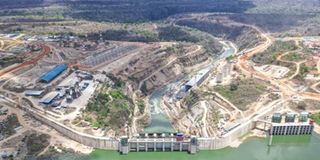
When President Samia Suluhu Hassan switched on the Julius Nyerere Hydropower Project in Rufiji last weekend, most coverage fixed on the obvious number: 2,115 megawatts, nine turbines inside a dam wall over a kilometre long, a Sh7.45 trillion price tag, roughly $2.9 billion, funded entirely from the government's own domestic budget rather than a foreign loan.
That matters, but it is not the number that should shape a Tanzanian investment decision. The number that matters is smaller, and far less flattering for a press release: which substation, on which line, is your project actually connected to.
Start with the financing, because it deserves the credit it is getting. The Sh7.11 trillion paid to contractors came from treasury allocations, not a loan or a multilateral facility with conditions attached.
No sovereign loan and no foreign guarantee sit on the government's books for this dam. The Egyptian contractor's own financing is separate: Elsewedy Electric and Arab Contractors drew on a $500 million Afreximbank facility in 2023, their arrangement, not Tanzania's sovereign debt.
For a country defending its fiscal discipline to rating agencies this year, that distinction is the whole point. Still, this may not a repeatable model.
The part that determines whether this dam changes anything for the investor across the table is that generation capacity is not the same asset as delivered capacity.
Tanzania's own transmission planners have said the network needs to roughly double before the grid can absorb what Rufiji now produces. The 400kV Chalinze-Dodoma line is complete and live; the Chalinze-Mkuranga-Kisarawe line and the Ibadakuli upgrade in Shinyanga are not.
That is the difference between a site that can draw on this power today and one still waiting on a wire. National capacity headlines flatten that distinction and corridors do not.
This is the diligence question I press on every industrial client before we get near a term sheet, and it is not one most legal opinions are built to ask.
A lawyer reviews the power purchase agreement, tariff, term, force majeure, termination rights, correctly and necessarily. What it will not tell you is whether the corridor feeding your site has the headroom to deliver, or whether you are buying paper capacity on a line still queued for an upgrade with no completion date.
That is a market intelligence question before it is a legal one, and it belongs inside the deal structure: conditions precedent tied to transmission completion dates, captive backup generation clauses for corridors still in preparation. A beautifully drafted PPA on an undelivered line is not an asset. It is a liability with a signature on it.
The same logic scales up regionally, where Tanzania now sits on a genuine surplus, roughly 2,375 megawatts once peak demand of 2,271 is netted against installed capacity of 4,646. A power purchase agreement with Zambia for 1,000 megawatts is concluded, and talks are underway with Kenya and the DRC.
Economist Zitto Kabwe's estimate of over a billion dollars a year in forex dovetails with the trade and minerals corridor Tanzania and the DRC agreed to deepen in Zanzibar this month.
Every cross-border agreement, though, lives or dies on the same physical question: which interconnector, on what redundancy, exposed to whose currency and grid stability.
None of this should overshadow what the project survived to get built. The dam sits inside what was, until 2019, the northern section of Selous Game Reserve, since renamed Nyerere National Park; UNESCO's own listing still runs under the Selous name.
In 2021 Tanzania spent real diplomatic capital persuading the World Heritage Committee not to strip that listing over the dam's footprint in Stiegler's Gorge and won. The ESG lens investors apply to infrastructure has only sharpened since, and one win does not exempt the next project in the Rufiji basin.
So here is the honest read: not the ribbon-cutting version: Tanzania has proved it can finance and deliver infrastructure at genuine scale on its own terms, buying real credibility with lenders it has not yet had to spend.
What it has not proved is that the surplus reaches the people meant to pay for it, at home, before it is sold abroad. Ask which corridor your project sits on. Everything else follows from that answer.
Amne Suedi is the Managing Director of Shikana Investment and Advisory, Honorary Consul of Switzerland in Zanzibar, and Chair of the Switzerland-Tanzania Chamber of Commerce. Views expressed are strictly Amne Suedi’s only.