Tanzania’s diplomatic triangle: What investors must now price in
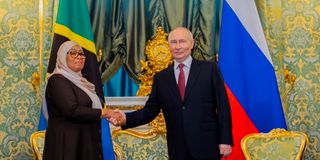
The President of the United Republic of Tanzania, Samia Suluhu Hassan, meets with the President of the Russian Federation Vladimir Putin, at the Kremlin in Moscow on June 3, 2026. PHOTO | COURTESY
On June 3, 2026, two things happened simultaneously. In Brussels, the European Parliament's Foreign Affairs and Development committees voted 81 to 1 to block €156 million in EU development funding for Tanzania.
In Moscow, President Samia Suluhu Hassan sat across from Vladimir Putin at the Kremlin, becoming only the second Tanzanian head of state to visit Russia since Mwalimu Julius Nyerere made the journey in 1969.
That same week, a bipartisan bill in the United States Senate, the “Reassessing the United States-Tanzania Bilateral Relationship Act”, introduced by Senators Shaheen and Cruz, proposed suspending US security assistance, development aid, and trade support pending certification of meaningful democratic reforms.
These three developments are not political noise. They are a structural shift in Tanzania’s external financing environment, arriving precisely as the government launches its most ambitious development agenda in a generation.
The EU committees’ objection is not yet final. A full Parliament plenary must ratify it within two months, requiring a majority of all Members of the European Parliament.
The Tanzanian government was right to note that the committee vote remains part of an ongoing process.
Tanzania’s Fitch B+ sovereign rating was reaffirmed in March 2026, and the country received the award for best public debt management office in Africa this year.
These are markers of institutional credibility that carry real weight in multilateral financing conversations.
However, institutional credibility and diplomatic credibility operate on different tracks. The EU objection, now on its second iteration after the Commission revised its original plan without satisfying Parliament, cites Tanzania’s refusal to allow a human rights subcommittee visit in May 2026 and the continued detention of opposition leader Tundu Lissu on charges carrying the death penalty.
Whatever one’s view of the underlying governance questions, the practical consequence for investors is concrete: EU-backed concessional financing, blended finance vehicles, and development-partner-supported infrastructure deals face increased procedural uncertainty for as long as this standoff persists.
The US bill sharpens that picture. Tanzania’s AGOA eligibility has not yet been formally challenged, but the bill creates the legislative architecture for that challenge if conditions are not met.
A bipartisan instrument in the Senate Foreign Relations Committee is not a symbolic gesture. It is a live one.
Into this environment, President Samia’s Moscow visit delivered a deliberate counterweight. The outcomes were substantive: Air Tanzania will launch direct flights to Moscow and Zanzibar from July 2; TISEZA signed an investment cooperation agreement with Russia’s Roscongress Foundation; and bilateral trade – up 20 to 25 percent in 2025 – is projected to generate over $2 billion in investment across mining, agriculture, energy, and infrastructure over the next three to five years. Tanzania also showcased the Bagamoyo Port project to Russian capital at SPIEF 2026.
Multi-vector foreign policy is not ideological realignment. It is what any sovereign economy does when traditional financing partners attach conditions it is unwilling to meet on the timeline demanded. The instinct is rational. But it carries pricing implications.
Russian capital operates in a different sanctions environment from Western institutional capital. Deals with Russian counterparties, particularly in energy and mining, will face additional due diligence layers from any co-investor or lender operating under US or EU regulatory frameworks. That is a structural complication, not a dealbreaker. But it must be priced in.
The deeper issue is Tanzania’s Vision 2050 financing gap. The government’s own figures, presented at the Tanzania Impact Investment Forum last week, identified $30 to $40 billion needed through to 2030, with 70 percent expected from the private sector.
Western DFIs and multilateral development banks are not the only source of that capital, but they are among the most concessional, the most scalable, and the most compatible with the blended finance structures Tanzania’s flagship projects require.
Narrowing the pool of willing partners at the moment the country needs to widen it, is a tension no amount of economic diplomacy fully resolves. Tanzania’s fundamentals remain compelling: 6 percent GDP growth, $6.3 billion in foreign exchange reserves covering 4.9 months of imports, private sector credit expanding at 23.5 percent, and exports at $17.6 billion in 2025.
These are the numbers of a country that needs sustained capital access to convert macro performance into structural transformation.
The June 3 convergence: Brussels, Moscow, Washington did not change Tanzania’s fundamentals. It changed the environment in which those fundamentals must be financed. Investors operating in this market should read it accordingly.
Amne Suedi is the Managing Director of Shikana Investment and Advisory, Honorary Consul of Switzerland in Zanzibar, and Chair of the Switzerland-Tanzania Chamber of Commerce.