Fighting poverty with an ecosystem of proven solutions
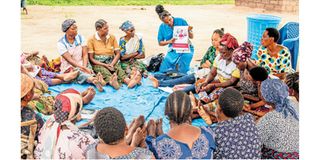
Community Organizer in a Microfinance Group from BRAC Tanzania Finance Ltd facilitating a financial education session to the clients.
It has been 20 years since BRAC set foot in Tanzania as a committed partner in pioneering and scaling proven solutions to poverty and inequality.
With half its population under 30, Tanzania is a nation full of possibilities, yet almost half the country still lives on less than USD 3 per day. Since 2006, BRAC in Tanzania has been supporting the Tanzanian government and communities across the country, particularly women and young people, to break the cycle of poverty and inequality.
Since its inception in Bangladesh over 50 years ago, BRAC has worked with communities to address the causes, not merely the symptoms, of deeply entrenched poverty and social injustice.
It traces its history back to 1972, when it began as a small relief effort after Bangladesh's Liberation War. It is now one of the world's largest development organisations born in the Global South, partnering with over 145 million people across Asia and Africa.
One belief guides most of its work: poverty is multidimensional, and so it requires multidimensional solutions. This is why BRAC integrates education, health, financial inclusion, livelihoods, food security, and social enterprise, not as separate programmes, but as an inter-connected ecosystem designed to create lasting change.
That ecosystem is visible across BRAC's 20-year history in Tanzania. Nearly 200,000 farmers, 65% of whom are women, have increased agricultural production and improved household nutrition since partnering with BRAC. Smallholder farmers are equipped with quality inputs including seeds, fertilisers, pesticides, and livestock feed, alongside access to finance and stronger links to markets.
Access to financial services is also a core part of BRAC’s holistic approach to development, complementing its social programmes to drive sustainable change and support people to lift themselves out of poverty.
BRAC Tanzania Finance Limited is the largest microfinance institution in the country, providing people who would otherwise be shut out of formal financial systems, with responsible financial services, and the tools to invest in themselves, their families, and their communities. As of March 2026, BRAC Tanzania Finance Limited serves nearly 450,000 clients across 228 branches nationwide, with 96% of those clients being women.
Sustainable transformation depends on strong partnerships. BRAC partnered with Tanzania's Ministry of Health and Community Development to strengthen early childhood education, resulting in a caregivers' guide and a play-based curriculum for children aged 2 to 4, both later adopted as national resources. These tools gave caregivers and educators practical support for children's cognitive and social development at the most formative stage of their lives.
In 2020, BRAC set up its first social enterprise in Tanzania to give more children a strong start through a network of microentrepreneurs who build on BRAC’s play-based learning model. The model is designed to make quality early childhood education more affordable and sustainable.
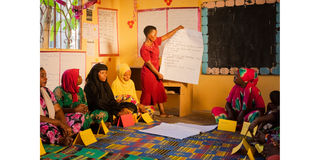
A club session for the adolescent girls implemented by BRAC Maendeleo Tanzania.
It works by charging fees at centres serving middle-income families, and using that income to keep costs low at centres serving lower-income families, as well as a mobile learning unit that brought early childhood education directly to communities.
Today, there are 13 Angaza Learning Centres across Dar es Salaam which are not only improving access to early learning but also creating employment opportunities and supporting local entrepreneurs, particularly women, to run and grow sustainable enterprises within their communities.
Along with an early childhood development programme, BRAC has expanded its focus to prepare young people for the evolving job market. In 2020, it launched a pilot programme in Dar es Salaam equipping secondary school students, particularly girls aged 14 to 24, with digital and practical life skills.
Participants gained not only technical know-how, but a clearer sense of direction and the confidence to pursue it, alongside a better understanding of their health and rights. Complementing this, a separate programme uses the power of sport to deliver life skills education to adolescent girls and young women aged 15 to 24 in low-income communities, building self-confidence, leadership, and decision-making skills, and enabling many to stay in school, avoid early marriage, and navigate social pressures with greater agency.
Together, these two initiatives have reached over 3,000 young people directly, with a goal to grow these numbers and open real pathways into technology and work for young people.
Building on five decades of evidence-based, integrated approach to empower young people, BRAC in Tanzania started its most ambitious programme yet in 2022. It has partnered with adolescent girls and young women from vulnerable communities with the overarching goal of improving their quality of life.
The programme is part of the Mastercard Foundation’s Young Africa Works strategy, targeting to support 30 million young Africans – 70% of whom are young women access dignified work by 2033. In Tanzania, the ambitious programme will reach over 700,000 adolescent girls and young women in the next seven years, with access to safer and higher-quality learning environments, age-appropriate entrepreneurship, employability, and life skills training, as well as the tools to start and scale their own businesses.
The programme is working with families, communities, and local actors to create a more supportive environment that encourages positive social and behavioural change for girls and young women.
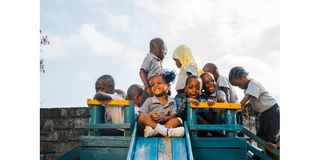
Through safe, joyful environments, Angaza Learning Centre nurtures children’s confidence, wellbeing, and readiness for lifelong learning.
All of this work is tied to one central theme: placing communities at the centre of development to foster self-reliance, so they can be the drivers of their own change.
In a moment when traditional development models are faltering, aid is less predictable, and challenges are growing more complex, BRAC's experience in Tanzania offers something quietly radical: proof that real change is not delivered from the outside. It is built patiently, pragmatically, from within communities who shape it, own it, and ultimately lead it.