Young women are finding value in what others throw away in Tanga City
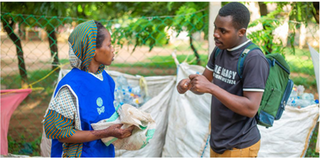
Kijana na Mazingira Project Officer Athumani Ramadhani speaks with Zainabu Juma at her Centre in Mzingani, Tanga. Zainabu was one of the women who did take waste a serious business at the first sight.
When Grace Kileo talks about the years she spent buying recyclable waste under a tree in Mwanzange, she does not romanticise it.
“I was working in very difficult conditions. I was not meeting my needs as required,” she says.
There was no proper structure. No formal recognition. No stable buyers. She bought hard plastics, scrap metal and nylon from whoever passed by. Some days she made sales, some days she did not. The work felt temporary, uncertain.
Today, she manages one of eight Taka Benki (Waste Banks) operating in Tanga City under the Kijana na Mazingira Project implemented by Zaidi Recyclers and Taka Ni Ajira Foundation under the TangaYetu program. The difference, she says, is not only physical, it is economic.
“In the monthly collection of about three tons, I have collected waste worth around 800,000 shillings,” she explains.
It is not a profit. It is a turnover generated by aggregating materials, sorting them carefully and selling in bulk to larger buyers. But the shift from buying “under a tree” to managing a recognised collection centre has altered both her income and how she is perceived.
“Since I received this Taka Bank centre, I meet all my needs… and sometimes I even have a small savings left,” she says.
House rent is paid, School fees are covered. That stability did not exist before.
Seeing waste differently
Across town in Central Ward, Salma Abdallah Kayumba’s entry into the waste sector came from a different direction. She trained as a nurse and once earned about 350,000 shillings per month. After her contract ended and later working at a hotel, she chose something less conventional.
“I like being free. I don’t like being employed. I prefer to employ myself,” she says.
Before joining the project, she admits she knew little about waste management.
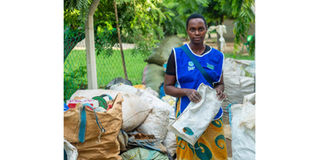
Grace Kileo at her Taka Benki Centre in Tanga, where she now collects and sells recyclable waste after starting her business under a tree.
“Before I joined this project, I didn’t know anything about waste. But after the training I have learned many things, to the extent that I feel like I have become a teacher.”
At her Taka Benki (Waste Bank) in Uzunguni, the pricing is precise. Plastic bottles are bought at 200 shillings per kilo. Hard plastics at 400. Nylon at 300. Rubber at 150. Scrap metal at 700.
The work requires patience. Some days she collects up to 150 kilos. Other days fall short. Markets fluctuate. Buyers sometimes purchase selectively, leaving part of the stock waiting.
She has not yet matched her former salary. “I am still searching for my level, and I believe I will reach the level I used to earn,” she says. There is no illusion of overnight success. But there is ownership.
How the model actually works
The Kijana na Mazingira Project established eight Taka Benki (waste banks) across Mwanzange, Mzingani, Central, Chumbageni and Nguvumali wards.
Waste reaches these centres through three channels: street waste pickers, municipal collection points and households encouraged to separate recyclable materials at source.
Once delivered, materials are weighed, emptied and sorted carefully.
“After being weighed, the waste is poured out and separated to put each material in its respective category to avoid mixing and reducing quality,” explains Project Officer Athumani Ramandani.
Suppliers are registered, names and source details are recorded and digital systems track volume and value. The formality is deliberate. The centres are recognised by the City Council, distinguishing them from informal roadside buying.
The project’s objective, Athumani says, is to enable young people “to see waste as an opportunity and earn from it.”
When the community starts to notice
In Mzingani, Zainabu Juma Kasimu did not initially see waste as serious business.
“At first I did not see waste as an opportunity, but after receiving education I understood,” she says.
On her first major sale, she moved materials worth 350,000 shillings and made a profit of 120,000. Rather than spending it, she reinvested.
“I added it and started collecting a second batch so that my money could continue growing and the profit become bigger,” she explains. She also says the change is visible not only in income but in status.
“When we first started, the community used to wonder about me. Now they consider me a very important person.”
Grace describes a similar shift. “Now the community gives me cooperation… they come to see what I am doing and support my business,” she says.
Waste trading, once dismissed as marginal, now carries a different weight when it operates through a structured centre.
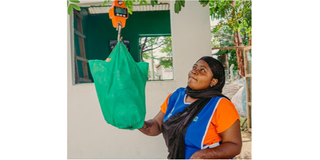
Salma Abdallah Kayumba weighs recyclable waste at her Taka Benki Centre in Uzunguni, Tanga where she now runs her own business after leaving formal employment.
The real impact
The environmental effect is measurable in volume rather than slogans. Materials that might have ended up in drains or informal dumps are redirected into recycling streams. Data collected through the centres allows tracking of how much is handled.
But for the women running these centres, the more immediate transformation is financial and psychological.
Zainabu puts it plainly: “Through the Taka Benki it has changed my life… it has given me permanent employment and increased my income compared to before.”
Grace’s aspiration extends beyond her own business.
“My future plan is to become a good environmental custodian and a good community mobiliser in the whole issue of environmental conservation and waste purchasing activities,” she says.
Salma is focused on growth, expanding her network, increasing volume and eventually stabilising her earnings.
The work remains practical, it involves scales, sacks and negotiation. Prices rise and fall. Buyers are selective and expansion requires transport and capital.
There are only eight Taka Benki (Waste Banks) in Tanga. But within those eight centres, waste is no longer something to discard. It is stock, It is a working capital. It is the difference between irregular income and measurable turnover.
And for the young women managing them, that difference is already reshaping what self-employment looks like in the city.