How church-led micro-credit empowers Zanzibar traders
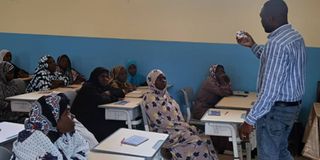
Financial specialist Mr Joseph Mushi conducts training for women entrepreneurs at Mahonda Primary School on Sunday, July 19, 2026. The programme was organised by the Catholic Diocese of Zanzibar in North B District, North Unguja Region. PHOTO | JESSE MIKOFU
Dar es Salaam. In deliberate efforts to uplift local women financially, the Catholic Diocese of Zanzibar has introduced a strategic programme equipping grassroots entrepreneurs across North B District, North Unguja Region, with capital assets and commercial interest-free credit lines.
This intervention seeks to foster long-term self-reliance, preventing beneficiaries from remaining entirely dependent on family relatives.
Beyond accessing interest-free credit, the capacity-building sessions encompass basic business management, value addition, and resource mobilisation via grassroots village community banks and collaborative group micro-finance systems.
Interviewed separately on Sunday, July 19, 2026, after undergoing training under the Community Empowerment in Justice and Good Governance (CEJG Phase V) project executed by the diocese's development directorate, various traders detailed how the newly acquired knowledge directly addresses their everyday commercial operational growth and demands.
A Misufini-based smallholder specialising in tailoring bedsheets and sofa coverings, Ms Amina Alfred Mhana, emphasised that modern women must proactively seek financial independence rather than depending entirely on male relatives for household sustenance.
"Besides securing credit, our fiscal management capabilities have improved significantly; thus, women should work industriously to comfortably cushion domestic financial obligations and daily household requirements," said Ms Mhana.
She noted that participants learned proper budgeting and fiscal respect, adding: "You might acquire capital, even minor sums, but without strict financial accountability, you will never witness the visible fruits of whatever business you choose to run."
A fresh produce retailer operating within Mkataleni Shehia, Ms Selima Juma, noted that severe commercial losses remain a recurrent challenge because steep procurement costs frequently outweigh daily retail revenues.
"For example, purchasing a tomato crate requires Sh80,000 or Sh120,000; yet adverse market fluctuations mean I occasionally generate profits, whereas on alternative days I recoup barely Sh70,000, completely failing to cover my initial wholesale capital investments," explained Ms Juma.
Nevertheless, she remarked: "I believe this entrepreneurial literacy and zero-interest credit structure will greatly cushion our operations and stimulate sustained long-term business growth."
Ms Juma, who single-handedly sustains five dependents, confessed she previously lacked awareness regarding micro-credit facilities because she historically operated individually rather than joining established progressive cooperative associations.
A micro-trader from Mahonda Shehia, Ms Jamila Hamad Haji, explained that she ventured into commerce to feed her household after her husband fell ill, leaving the family without any stable breadwinner.
She said that from her daily operations, she could earn Sh5,000 but lacked a savings culture because she considered the amount too small.
"However, today's training highlighted the importance of thrift; even during financial scarcity, one should avoid total expenditure because accumulated pennies gradually expand your capital base to securely protect your family's future," said Ms Haji.
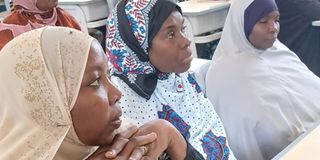
Women entrepreneurs in North B District follow a training session on financial discipline and business development run by the Catholic Diocese of Zanzibar’s development department at Mahonda Primary School in North Unguja Region on Sunday, July 19, 2026. PHOTO | JESSE MIKOFU
Similarly, a fried cassava vendor from Donge Majenzi Shehia, Ms Zaina Mohamed Bakari, utilises her modest commercial proceeds to finance formal schooling and madrasa education for her eight children.
Institutional support and dynamic outreach
The diocese's development department monitoring and evaluation officer, Mr Msafiri Thomas, stated that the ongoing intervention specifically targets underprivileged households to ensure that impoverished local parents can successfully finance their children's foundational needs.
"Alongside capacity building, we disburse interest-free revolving group credit; compliant borrowers quickly qualify for higher tranches within self-selected groups of 10 to 15 members who collectively guarantee one another," explained Mr Thomas.
Regarding the geographic outreach of these micro-credit interventions, he revealed they successfully operate across Mahonda, Misufini, Kitope, Mkataleni, and Majenzi.
Mr Thomas added that group constitutions, application forms, and statutory registers have already been drafted and formally endorsed by the respective local leaders.
For his part, financial specialist and micro-credit facilitator Joseph Mushi argued that local traders share uniform bottlenecks, fundamentally rooted in low commercial literacy, which regularly perpetuates repetitive structural operational errors.
"Many traders operate informally out of pure habit without clear milestones, lacking the fiscal discipline required to satisfy long-term targets; conversely, establishing objectives and maintaining structural consistency guarantees long-term profitability," advised Mr Mushi.
Bumbwini Misufini, local leader (sheha), Mr Khamis Ussi Mlinde, commended the initiative, noting its direct capacity to successfully emancipate impoverished community members.
"We embraced this programme wholeheartedly because it inspires local women to attain financial self-actualisation, and structural behavioural transformations are already highly evident as they absorb these critical skills," noted Mr Mlinde.
He challenged residents to participate fully, warning against complacency: "Embracing this practical framework will ultimately liberate our households from chronic economic hardships altogether."