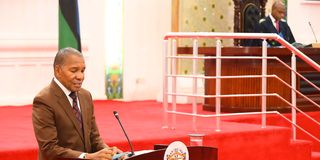
Acting Minister for Trade and Industrial Development Shariff Ali Shariff presents the ministry’s 2026/27 budget estimates during a session of the House of Representatives in Unguja, Zanzibar. PHOTO | JESSE MIKOFU
The ministry plans research on local raw materials for industrial development and studies on products consumed by visitors to guide investment decisions
Unguja. The Ministry of Industry and Trade has outlined three key priorities aimed at strengthening Zanzibar’s industrial sector, expanding markets and improving the business environment and service delivery.
However, members of the House of Representatives have called for a more coordinated industrialisation strategy, warning that high taxes and fragmented regulatory systems continue to constrain business growth.
Presenting the ministry’s 2026/27 budget estimates in the House on May 21, 2026, Acting Minister Shariff Ali Shariff said the ministry has been allocated Sh49.95 billion.
He said Sh2.94 billion is for recurrent expenditure, Sh3.26 billion for salaries, Sh34.26 billion for development projects and Sh9.48 billion for subsidies to semi-autonomous institutions under the ministry.
Mr Shariff said priorities include upgrading trade infrastructure, including works at the Dimani exhibition grounds where a multipurpose hall and restaurant will be constructed.
Feasibility studies for a proposed International Conference Centre (MICE), funded by Korea Exim Bank, will also be undertaken.
On improving the business environment, he said the ministry will develop a formalisation strategy for businesses and review key laws, including the Business Act of 2013, licensing regulations, scrap metal rules and copyright legislation.
He added that systems to curb counterfeit goods will be introduced, alongside integration of the TAMS system with court systems to strengthen enforcement.
The ministry also plans research on local raw materials for industrial development and studies on products consumed by visitors to guide investment decisions.
On industrial growth, Mr Shariff said industrial zones at Dunga Zuze and Chamanangwe will be upgraded, including construction of factory buildings, fencing and road infrastructure.
The Zanzibar State Trading Corporation (ZSTC) is expected to sell 2,964 tonnes of produce at an average price of US$7,200 per tonne and purchase 600 tonnes of dried copra at Sh2,000 per kilogramme.
However, the House Committee on Tourism, Trade and Agriculture expressed concern over slow disbursement of development funds, noting that less than 28 per cent of allocated resources had been released, delaying project implementation.
Lawmakers also raised concern over staffing shortages in Pemba, where only one officer is assigned to industrial development, and called for a clearer industrial policy, reduced tax burdens and improved coordination of business licensing systems.