Zanzibar government to repossess over 300 idle plots in Unguja
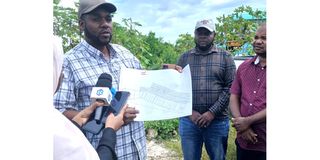
The Zanzibar Lands Commission Executive Secretary, Mr Mussa Kombo Bakari, on Sunday, May 10, 2026, shows a map of plots allocated by the government to residents in the Southern District of South Unguja Region, which they have failed to develop. PHOTO|JESSE MIKOFU
Unguja. More than 300 plots allocated by the government to residents in the South District, South Unguja Region, are set to be repossessed and reassigned for alternative use after beneficiaries failed to develop them.
Under the provisions of the Land Use Act No. 12 of 1992, land allocated to a citizen must be developed within two years, failing which authorities are empowered to revoke ownership.
Speaking on Sunday, May 10, 2026, after inspecting areas covering the shehias of Tasani, Mzuri, and Kiongoni Makunduchi, the Zanzibar Lands Commission Executive Secretary, Mr Mussa Kombo Bakari, said the plots were issued between 2011 and 2013, meaning over 15 years have elapsed without development.
“The government’s intention was good. These areas were meant to develop into proper urban settlements and residential zones. But as we can see, most of the land remains bushy, which was not the plan,” said Mr Bakari.
He clarified that the development of plots refers to the construction of houses, not perimeter walls or fences, which are considered only security features rather than development.
“Under the law, these plots are subject to repossession, and the government will consider alternative uses for the land,” he said.
Mr Bakari urged beneficiaries and land buyers to develop their plots instead of leaving them idle, stressing that the law provides a two-year window before enforcement action is taken.
“We do not intend to take away people’s land, but where development does not take place, we must make alternative arrangements so towns can be properly planned and housing needs addressed,” he said.
He added that although the government does not seek to punish citizens, action will be taken where necessary as many people continue to require land for housing and investment.
Mr Bakari noted that the government is pursuing organised settlement plans and structured urban development, warning that idle land undermines those efforts.
He said the expectation at the time of allocation was that the areas would now have developed towns with supporting infrastructure and services.
“This area was supposed to be a fully developed settlement with proper infrastructure and services,” he said.
He added that properly developed land would benefit individuals, communities, and the wider economy, whereas idle land currently generates no value.
He further warned that continued neglect could lead to illegal occupation and unplanned construction, which would compromise development planning.
Shehia leaders in the affected areas said proper utilisation of the plots would significantly transform the region.
Mzuri Shehia, Secretary, Mr Mohamed Issa Change, said the land had remained unused for a long time and that although an investor once showed interest, existing planning arrangements stalled progress.
“These are large areas that remain idle, and owners are not developing them. It may be better if alternative arrangements are considered to support development,” he said.
Tasani Shehia, Secretary, Mr Mbwana Khamis, also said that if alternative solutions are found, the land could help create planned urban settlements and stimulate economic growth in the district and region at large.