Unguja. Members of Zanzibar’s House of Representatives have raised concerns over the security of government data, warning that continued reliance on systems developed and hosted by foreign companies could expose the country to security risks.
The lawmakers also criticised the lack of interoperability among government systems, saying the failure of public institutions to share information continues to inconvenience citizens and undermine service delivery.
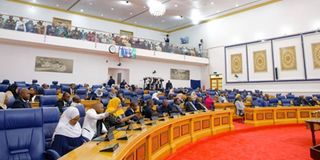
The concerns were raised yesterday during debate on the revenue and expenditure estimates of the Ministry of Communications, Information Technology, and Innovation held in the House of Representatives in Chukwani, Unguja.
Contributing to the debate, Paje Representative Jaku Hashim Ayub (CCM) questioned the security of government information stored on systems developed and managed outside the country.
“Many of these systems are developed and hosted abroad. We understand the importance of protecting government information, but how secure can that information be when the systems are outside our control? The time has come for us to develop and manage our own systems,” he said.
Similar concerns were raised by Ole Representative Seif Hamad Suleiman (ACT-Wazalendo), who argued that hosting government systems abroad poses potential security threats and questioned why the country continues to depend on foreign technology providers.
He also highlighted persistent internet connectivity challenges, saying poor and unreliable services continue to hamper efforts to promote innovation and digital transformation.
“We cannot achieve meaningful innovation without reliable and high-quality internet services.”
Mr Suleiman further noted that the lack of communication between government systems remains a major challenge for citizens seeking public services.
“Every office requires people to provide the same information repeatedly. We need to know what plans are in place to ensure government systems can communicate with one another.
Data and systems across institutions must be integrated,” he said.
According to him, fragmented systems may contribute to citizens being denied services and rights while also creating concerns over data management and security.
“When you compare birth and death records, you often find inconsistencies.
That happens because the systems are not integrated. If they were connected, many of these challenges would be eliminated,” he added.
Special Seats Representative Aza Januari Joseph (CCM) said the lack of interoperability continues to inconvenience citizens, while reliance on foreign experts to develop government systems increases costs whenever technical problems arise.
“You can go to a hospital for treatment and realise you have forgotten your health insurance card.
Even if you have another form of identification, it may not help. We need systems that reduce the need to carry multiple cards and documents,” she said.
Earlier, while presenting the ministry’s budget estimates, Minister Mudrik Ramadhan Soraga sought approval of Sh53.391 billion to implement four priority areas in the next financial year.
Among the priorities is creating an enabling environment through the formulation, review, and implementation of the 2026 Zanzibar Digital Policy, while continuing preparations for the Start-ups and Innovation Bill.
The ministry also plans to enact an Information and Communications Technology Act and complete preparations for a Personal Data Protection Bill.
Other priorities include strengthening and expanding the National Addressing System through continued registration, verification, and issuance of residential addresses, while increasing its use in digital service delivery and raising public awareness of its benefits.
The ministry also intends to promote innovation and support the growth of start-up companies through ICT and digital literacy training at community ICT centres, alongside continued construction of the Innovation and Entrepreneurship Centre.
In addition, the government plans to improve access to communication services by working with the Universal Communications Service Fund and telecommunications companies to construct communication towers in underserved areas of Unguja and Pemba.
Committee observations
The Infrastructure, Lands, and ICT Committee said that although the establishment of the ministry reflects the government’s commitment to digital transformation, its current budget allocation remains inadequate.
Presenting the committee’s observations, Vice Chairperson Mwanaidi Kassim Mussa said the Ministry of Finance should review the ministry’s budget to ensure it has sufficient resources to fulfil its mandate.
“As a relatively new ministry, significant financial investment is required to enable it to support all sectors in the areas of communications, information technology, and innovation,” she said.
The committee also recommended that the ministry be allocated a permanent office building to accommodate its leadership and affiliated institutions.
“This ministry plays a critical role in the country’s development, particularly in this digital era and in line with the government’s vision of building a digital economy,” she said.