The book follows four characters: Scurry and Sniff, two mice, and Hem and Haw, two little human beings. The mice have simple brains and sharp instincts. The little people have complex brains, full of beliefs and emotions. Both are searching for Cheese in a maze.
Cheese, Johnson tells us, is whatever gives your life meaning. A job. A relationship. A sense of your own indispensability.
Last year, I received notice that my position had been terminated. So did everyone else in my organisation. We had known a restructuring was coming; it had been hinted at for months, but I had somehow convinced myself I was safe. My skills, my position, my experience. Surely that counted for something. It did not. The letter arrived as it arrives for everyone.
We were then invited to reapply for positions in the new structure. I did, and I was among those who stayed. Others did not. In the weeks that followed, I had this strange, uncomfortable feeling of inadequacy, the feeling of someone who had been certain of the ground beneath her feet, and discovered, at the last moment, that certainty had been entirely her own invention. I grieved for the ones who had to go. I grieved for my past self. And I still feel guilty sometimes for staying.
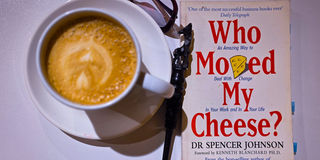
This weekend I found myself thinking about all of that, and about a little book I read years ago, Spencer Johnson's Who Moved My Cheese? A parable about change, yes. But really, a parable about what we tell ourselves to avoid facing it.
The book follows four characters: Scurry and Sniff, two mice, and Hem and Haw, two little human beings. The mice have simple brains and sharp instincts. The little people have complex brains, full of beliefs and emotions. Both are searching for Cheese in a maze.
Cheese, Johnson tells us, is whatever gives your life meaning. A job. A relationship. A sense of your own indispensability.
Because that is exactly what I had built my maze around, the belief that I was too useful to lose. And the book’s uncomfortable argument is that it doesn’t matter how good your Cheese is, or how long you have had it, or how certain you are that it will always be there. The maze does not care about any of that.
This is a reality I learnt the hard way. But I am forgetful, as many of us are after life shakes us and we promise to do better. I am slipping into my old self, believing that this is it. I am safe now.
The four characters found Cheese at Station C. The little people got comfortable. Too comfortable. “There is enough Cheese here to last us forever,” they thought. But the mice stayed alert. They looked around and noticed things were changing. One morning, just like that, the Cheese was gone.
The mice did not hesitate. Cheese is gone, so they go find it somewhere else. As simple as that. But not the little people. They started overanalysing, as Johnson writes: “The little people couldn’t believe it. How could this have happened? No one warned. It wasn’t right. It was not the way things were supposed to be.”
I laughed as I wrote this quote because this is exactly how my thought process looked last year; the only difference is that last year, I thought this with tears in my eyes.
The moment you begin to notice the ridiculousness of your own actions may be the start of making better choices. Haw gets at that recognition eventually, laughing at himself, at the absurdity of waiting for a maze to apologise. I recognised that laugh. I have done it too, usually alone and usually too late.
But not everyone gets there as quickly as Haw does. Some of us are a Hem on a bad day. He was not ready to move, to leave Cheese Station C, because he believed the maze would come to its senses and bring the Cheese back. I sympathise with Hem because on my bad days, I am a Hem too, and I am not ashamed to admit it. Sometimes, not knowing what lies beyond your comfort zone can freeze you in place.
In the margin of one page, I wrote: It is told as a simple parable; one might say it is too simple to be taken seriously. But simple things are often the most serious ones.
Change can never be prevented, but you have a choice in how it finds you, scrambling and surprised, or alert and already moving. The mice never stopped watching the maze. They noticed before it was too late.
I am still learning to be a mouse. Some days I manage it. Other days, I am Hem, waiting for the Cheese to come back, certain that it will. What I know now that I did not know before the letter arrived is that certainty is not the same as safety.
Jane Shussa is a digital communication specialist with a love for books, coffee, nature, and travel. She can be reached at [email protected].