Josephine Christopher is a senior business journalist for The Citizen and Mwananchi newspapers
Mwananchi Communications Limitted
Yaoundé. Escalating conflict in the Middle East is set to slow global trade growth and push up energy costs in 2026, the World Trade Organisation (WTO) has warned, even as rising investment in artificial intelligence (AI) offers a critical buffer against a sharper downturn.
The WTO forecasts global goods trade growth will ease to 1.9 percent in 2026, down from 4.6 percent in 2025, with risks tilted to the downside.
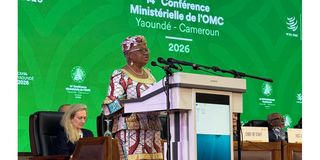
Opening the WTO’s 14th Ministerial Conference, Director-General Ngozi Okonjo-Iweala said geopolitical tensions—particularly in energy markets—pose the biggest threat to global trade this year.
“Prolonged high oil prices resulting from the Middle East conflict could lower this forecast by 0.5 percentage points, from 1.9 percent to 1.4 percent,” she said.
Services trade is projected to grow by 4.8 percent, but could slow to 4.1 percent if disruptions affect travel and transport, sectors highly sensitive to geopolitical instability.
The warning comes amid multiple conflicts—from the Middle East to Ukraine and Sudan—that are reshaping trade routes, supply chains and investor confidence.
Despite these risks, global trade has shown resilience, supported largely by a surge in technology-driven demand.
In 2025, tariffs and policy uncertainty dampened trade flows, but the impact was offset by import frontloading, favourable macroeconomic conditions and strong investment in AI.
Trade in AI-related goods, including semiconductors and processors, accounted for 42 percent of global trade growth, signalling a rapid shift in the structure of global commerce.
In value terms, trade in AI-enabling goods rose by 21.9 percent year-on-year to $4.18 trillion in 2025, up from $3.43 trillion in 2024.
Many of these products were shielded from new tariffs, with most inputs for data centres traded at low or zero duties under the WTO’s Information Technology Agreement.
Services trade also remained a bright spot, expanding by 5.3 percent last year, underscoring the growing role of digital and knowledge-based sectors.
According to the WTO, around 72 percent of global goods trade is still conducted under Most-Favoured-Nation (MFN) terms, helping to maintain predictability despite rising fragmentation.
“WTO rules are still providing global trade with a stable core, however much uncertainty is swirling around it,” Dr Okonjo-Iweala said.
Cameroon’s Prime Minister, Joseph Dion Ngute, called for stronger cooperation to navigate the uncertain environment.
“The shared prosperity we aspire to rests on strengthened cooperation, and the future we wish to leave for coming generations is built through dialogue and solidarity,” he said.
For developing economies such as Tanzania, the outlook presents a delicate balance—greater exposure to external shocks, but also expanding opportunities to tap into technology-driven trade.
As ministers meet in Yaoundé, the message is clear: while conflict may slow global trade, innovation—particularly in AI—is shaping the next wave of growth.