Why knowledge is central to Nyerere Leadership School
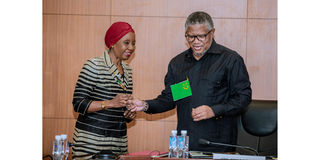
The Mwalimu Julius Nyerere Leadership School (MJNLS) Board of Trustees Chairperson and CCM Secretary General, Dr Asha-Rose Migiro (left) exchanges party flags with South Africa’s African National Congress (ANC) Secretary-General, Mr Fikile Mbalula during a meeting of the Board of Trustees held at the school premises in Kibaha, Coast Region. PHOTO|COURTESY
Kibaha. Knowledge and leadership training were highlighted as the core mission of the Mwalimu Julius Nyerere Leadership School (MJNLS) as the institution marked its fourth anniversary at its Kibaha campus.
Speaking during the commemoration, the school’s Board of Trustees chairperson and CCM Secretary General, Dr Asha-Rose Migiro, said the school was established to strengthen the intellectual capacity of liberation movements and prepare leaders to manage political and economic challenges facing African countries.
Dr Migiro said knowledge remains one of the most important tools for leadership, enabling decision-makers to respond to complex situations and develop practical solutions.
“Knowledge sharpens judgement, nurtures critical thinking, and equips leaders to navigate complexity with confidence and principle,” she said during her opening address to delegates and invited guests.
She emphasised that in the modern era, the true value of knowledge lies in its practical application, transforming ideas into workable policy and guiding principles into effective governance systems.
Dr Migiro said the school stands as a living continuation of the philosophy of Mwalimu Julius Nyerere, who believed political freedom must always be sustained by strong intellectual preparation and disciplined leadership development.
This message was echoed by African National Congress (ANC) Secretary-General Mr Fikile Mbalula, who joined the celebrations to honour the founding leaders of southern Africa's liberation movements and their enduring sacrifices.
Mr Mbalula reminded delegates that visionaries such as Nyerere, Nelson Mandela, Samora Machel, and Robert Mugabe envisioned an Africa that would be free in every sense of the word.
He said the dream included an Africa that is economically self-reliant, socially just, and governed by its own citizens in peace and democratic stability for generations to come.
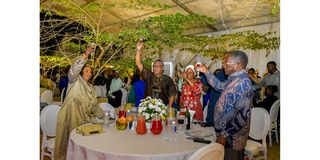
The Mwalimu Julius Nyerere Leadership School (MJNLS) Principal, Prof Marcellina Chijoriga (left), South Africa’s African National Congress (ANC) Secretary-General, Mr Fikile Mbalula, MJNLS Board of Trustees Chairperson and CCM Secretary-General, Dr Asha-Rose Migiro, and the School Governing Board Chairperson and former Prime Minister, Mr Mizengo Pinda, toast to celebrate the School’s fourth anniversary during a recent official ceremony held at its campus in Kibaha, Coast Region. PHOTO|COURTESY
“While political independence marked the first step, the leadership school exists to ensure the torch lit by earlier generations is carried forward into a new era of self-determination,” said Mr Mbalula.
Tanzania's historic role as a sanctuary for liberation movements remained a recurring theme throughout the anniversary commemorations held at the Kibaha campus.
Mr Mbalula noted that Tanzania once served as a second home for cadres in exile and as an important training ground for freedom fighters preparing for independence struggles.
He cited the legacy of the Solomon Mahlangu Freedom College (SOMAFCO) as a powerful symbol of solidarity and educational empowerment that supported disadvantaged youth during the darkest years of apartheid.
He said the MJNLS continues this proud tradition, serving as a beacon of Pan-African unity and transformative leadership for the continent's future generations.
A central focus of the anniversary was the expanding role of young people and women in shaping Africa's political and socio-economic future through informed leadership and responsible governance.
Mr Mbalula stressed that the continent's long-term progress depends heavily on its youthful population, praising the school's commitment to leadership development programmes designed to prepare future ministers, legislators, and civic leaders.
He also highlighted the indispensable contribution of women, noting that liberation struggles were never won by men alone but through the collective courage and sacrifice of entire communities.
“By ensuring women receive high-quality leadership training, the institution honours the legacy of those who organised communities and stood on the front lines of the struggle for justice and equality,” he remarked.
He said a new generation of confident and capable women leaders is already emerging from Kibaha, ready to continue the work of past heroines and strengthen democratic institutions across Africa.
Dr Migiro warned that the urgency of intellectual preparation is heightened by rapid technological change and increasingly contested global information environments that influence public opinion and policy debates.
She explained that modern public discourse is often shaped by competing narratives and external pressures capable of testing the discipline and unity of liberation movements and democratic institutions.
For her part, the school's Principal, Prof Marcellina Chijoriga, presented the Strategic Plan 2026-2030, describing it as a decisive step toward institutional maturity and long-term sustainability.
She said the plan prioritises stronger research capacity, expanded training delivery, reliable financing mechanisms, and full digital integration to produce leaders capable of driving governance reforms and socio-economic transformation across Africa.
She said that is done while preserving solidarity among partner parties and strengthening the school's mission to safeguard knowledge as the continent's enduring foundation.