‘Chadema member’ disowns Lissu in court

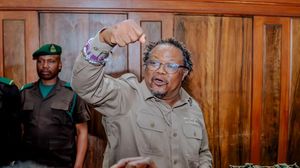
Dar es Salaam. The prosecution witness who identified himself as member of Chadema on Monday disowned the opposition party’s national chairman Tundu Lissu in court as he testified against him.

The eighth witness, identified as P8, aged 26, is among the protected witnesses who testify from a special enclosure where they cannot be seen by the public or the accused, but only by the judges.
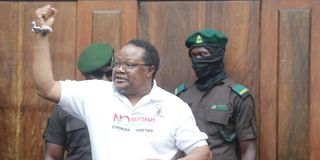
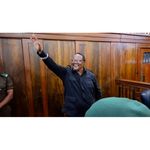
At the outset of his testimony, P8 introduced himself as a Chadema member but stated that Mr Lissu was not his chairman in the proceedings. He complained that Mr Lissu had caused him problems, prompting the accused to apologise.

Mr Lissu faces one count of treason, arising from remarks allegedly made on April 3, 2025 in Dar es Salaam, in which he is accused of inciting the public to obstruct the 2025 General Election.

The case is being heard at the High Court, Dar es Salaam Sub-Registry, before a three-judge panel led by Justice Dunstan Ndunguru, sitting with Justices James Karayemaha and Ferdinand Kiwonde.

Led in evidence by Senior State Attorney Nassoro Katuga, the witness said he lives in Njoro, Moshi, Kilimanjaro Region, and works as a fruit trader at Manyema Market in Mbuyuni. He told the court that he is involved in politics, though not deeply, through Chadema, and that he knew Mr Lissu as the party’s national chairman.

He testified that on April 4, 2025, while using his Oppo F1X smartphone, he accessed YouTube and watched a statement by Mr Lissu on Jambo TV. In that address, he said, Mr Lissu urged his supporters to rebel against the government and declared that they would “make things chaotic” and block the 2025 General Election if reforms were not implemented, using the phrase “no reforms, no election.”

The witness said he was motivated by the remarks, recalling the 2024 local government elections when, according to him, some of their local leaders were removed and replaced with CCM officials, something he said pained him deeply. He therefore decided to mobilise fellow youths in his neighbourhood while waiting for Mr Lissu’s directive to “make things chaotic.”

On April 8, 2025, while mobilising youths in the Njoro Pepsi area, he was arrested by police as his colleagues fled. He was taken to the office of the Regional Crime Officer (RCO) in Kilimanjaro and handed over to an officer identified as Rashid. Out of fear, he said, he chose to tell the truth and admitted that he had been mobilising youths to rebel in support of his chairman’s call of “no reforms, no election.”

He was detained and later released on bail at around 5pm, having self-bonded on condition that he report to police every Monday. He reported on April 14, 2025 and again on April 22, 2025, when his statement was recorded by an officer identified as Michael.

During cross-examination, the exchanges unfolded as follows:


Lissu: Witness, on April 22 did you write a statement at the police?

Witness: Yes.

Lissu: If shown that statement, would you recognise it?

Witness: That is a matter for the lawyers; they are the ones to decide whether to show it to me or not.

Lissu: I am asking you whether, if shown, you would recognise it.

Witness: The lawyers are the ones to decide.

Lissu: Witness, are you now arguing with your chairman?

Witness: You are an accused person. (The response caused laughter among members of the public in court).

Lissu: As the accused and you as the witness, please answer my question. If shown your statement, would you recognise it?

Witness: As I said, the government lawyers can decide whether to show it or not.

At that point, the prosecutor Katuga intervened:

Katuga: Witness, listen carefully to how the accused is asking you. Just answer as he asks. He is asking whether, if shown, you would recognise it. It is simple.

Witness: All right.

Lissu: (Repeats the question.)

Witness: I can recognise it if shown.

The statement was then shown to him. After confirming it was his, Mr Lissu asked that it be produced as a defence exhibit. The prosecution said it had no objection, and the court admitted it as defence exhibit.

Lissu: You have repeatedly said in court that the chairman said he would “make things chaotic.” What does that mean?

Witness: You are the one who said you would make things chaotic.

Lissu: Do you know what “making things chaotic” (kukinukisha) means in Kiswahili?

Witness: I know what “making things chaotic” means. I do not know about the rest.

Lissu: You said what motivated you to mobilise youths was what happened during the 2024 local government elections?

Witness: Yes.        

Lissu: So your anger was due to election vote theft?

Witness: That is your opinion. Let us stick to the point.

Lissu: You said you were waiting for the chairman’s directive to “make things chaotic.” From April 4, 2025 until now, was that directive ever carried out?

Witness: You are already an accused person.

Lissu: After waiting for my directive, did you decide on your own to mobilise youths to rebel?

Witness: (Silent)

Lissu: All right, witness, let me finish with a few questions. You are my young man; I do not want to gmake you tired.

Witness: I am not your member, accused.

Lissu: Have you turned against me?

Witness: Because you have placed me in trouble. I did not expect to find myself in a place like this.

Lissu: Sorry if I have brought you into these misfortunes.

Witness: In your view, do you think these are good things?

Mr Lissu further asked whether any leader or party member had threatened his life in connection with the case.

Witness: I have not been directly threatened, but I saw on social media that “whoever testifies in our chairman Tundu Lissu’s case, we will deal with him.”

Lissu: Who said that? Does that person have no name?

Witness: I cannot mention his name for my own safety, but he is a man.

Lissu: Did you report this to the police?

Witness: I went to Officer Rashid. He told me not to worry, that I would be safe.

Lissu: Why did you not file a formal report with the police?

Witness: Because they do not know me, and those people have never known me.

Lissu: Would I be correct to say that your rebellion case was dropped so that you could come and testify in Lissu’s case?

Witness: You would not be correct.

Lissu: For the offence of mobilising rebellion, why were you not charged in court?

Witness: First, I thank the government — truly, leave the government out of this. If I had refused to tell the truth, the government has a long arm and would have arrested me. But the truth sets a person free.

He added that on the day he was arrested and taken to the police station, he told the truth and still could not believe he remained free to this day.

His remarks triggered laughter and murmurs in court for several seconds before Justice Ndunguru called for order.

The case was adjourned to Tuesday for continuation of hearing.